
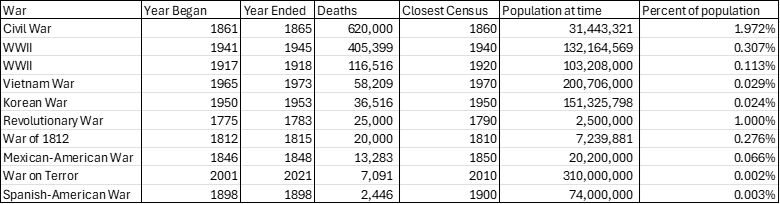
The human toll of warfare is often measured in absolute numbers, yet such figures can obscure the relative burden on societies of differing sizes. This analysis adjusts U.S. military fatalities for contemporaneous population estimates, providing a per capita perspective on ten major conflicts. By dividing deaths by the nearest decennial census population, this approach highlights how earlier wars, waged amid a smaller national populace, imposed proportionally greater sacrifices. Data drawn from aggregated military fatality records and official census enumerations.[1]
Methodology and Contextual Notes
Fatality estimates derive from compiled U.S. Department of Defense and historical sources, encompassing combat and non-combat deaths (primarily disease in pre-20th-century conflicts). Population figures utilize the closest decennial census, with approximations for pre-1790 eras based on historical demographic consensus. Per capita rates are expressed as percentages for comparability.
Per Capita Ranking (Lowest to Highest)
10. War on Terror (2001–2021) This protracted series of operations, centered on Iraq and Afghanistan, resulted in approximately 7,091 American military deaths. Against a median population of roughly 309 million (2010 census), the rate equates to 0.0023%—or about two deaths per 100,000 inhabitants. As the longest U.S. conflict, spanning two decades in Afghanistan alone, technological and medical advances mitigated proportional losses, despite the eventual return of Taliban control.[1]]2]
9. Spanish-American War (1898) Described contemporaneously as a “splendid little war” due to its brevity (three months), this imperial expansion effort incurred 2,446 deaths, largely from diseases like yellow fever rather than battle. Relative to a population of approximately 76 million (1900 census), the per capita impact was 0.0033%.[1][3]
8. Korean War (1950–1953) Frequently termed the “Forgotten War,” this Cold War proxy confrontation claimed 36,516 American lives under harsh environmental conditions, including extreme cold and large-scale Chinese offensives. With a 1950 population of 151 million, the rate stands at 0.024%. Notable actions included the Pusan Perimeter defense, Inchon amphibious landing, and the Chosin Reservoir retreat.[1][4]
7. Vietnam War (major combat operations 1965–1973) This polarizing conflict resulted in 58,209 deaths amid a 1970 population of approximately 203 million, yielding 0.029%. Domestic divisions intensified scrutiny of the military-industrial complex, while operational constraints—often likened to fighting with restricted capabilities—and exposure to Agent Orange contributed to both immediate and posthumous tolls, the latter potentially unquantifiable.[1][5]
6. Mexican-American War (1846–1848) Though frequently overlooked in modern historiography, this expansionist campaign profoundly altered national boundaries, incorporating roughly 525,000 square miles of territory (present-day California, Nevada, Utah, most of Arizona and New Mexico, and portions of Colorado and Wyoming) via the Treaty of Guadalupe Hidalgo. Fatalities totaled 13,283 against a 1850 population of 23 million, producing 0.066%—over twice Vietnam’s rate. Disease predominated as the cause of death.[1][6][7]
5. World War I (U.S. engagement 1917–1918) U.S. involvement, concentrated in 1918 following entry in 1917, generated 116,516 deaths amid trench warfare, chemical attacks, and massed infantry assaults—conditions regarded by some observers as uniquely deplorable in daily existence. Relative to a 1920 population of 106 million, the per capita rate was 0.113%. Limited duration spared higher cumulative losses.[1][8]
4. War of 1812 (1812–1815) Estimates indicate around 20,000 American deaths in this early republican struggle, set against an 1810 population of 7.2 million, resulting in 0.276%—more than double World War I’s proportion. Initial military setbacks, including the British incineration of the White House, contrasted with later morale boosts, exemplified by Andrew Jackson’s post-treaty victory at New Orleans.[1][9]
3. World War II (1941–1945) The most expansive global conflagration recorded 405,399 American fatalities within a 1940 population of 132 million, equating to 0.307%. This conflict uniquely featured combat deaths exceeding disease-related ones among U.S. forces, culminating in elevation to superpower status.[1][10]
2. American Revolutionary War (1775–1783) Though modest in absolute scale, this foundational independence struggle entailed an estimated 25,000 deaths. With demographic records being sparse before 1790, the era’s population is estimated at 2.5 million, yielding roughly 1%—one in every hundred inhabitants. Patriots contended with severe winters, epidemics, and privation to secure national sovereignty.[1][11]
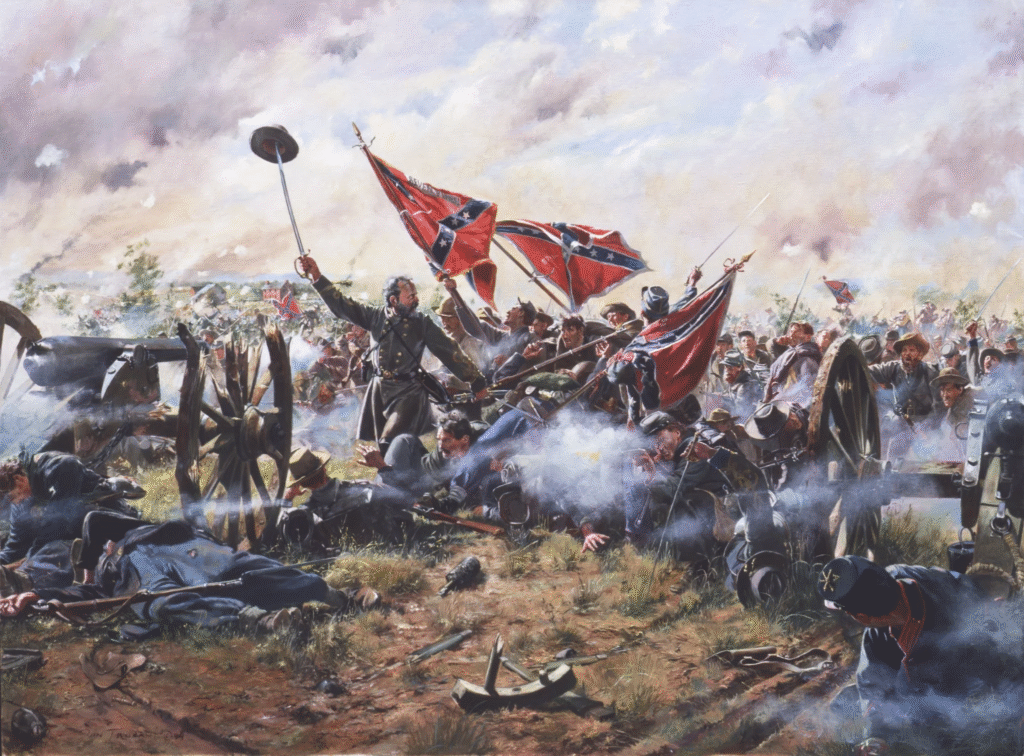
1. American Civil War (1861–1865) The conventional aggregate of 620,000 deaths (encompassing Union and Confederate forces) against an 1860 population of 31.4 million produces approximately 2%—one in fifty individuals. Engagements such as Gettysburg, Antietam, and Chickamauga exemplified industrialized slaughter, permeating societal fabric, particularly in the South, where few families remained unaffected. [1][12]
Contemporary scholarship, leveraging enhanced demographic methodologies and full-count census linkages, revises this upward. A 2024 analysis estimates 698,000 total deaths, with prior studies reporting ranges of 750,000–850,000 (corresponding to 2.2%–2.7%). Higher-end scenarios suggest Confederate losses consumed up to 46% of military-age white males, eradicating entire communities and delaying Southern demographic recovery by decades—or, in some interpretations, permanently. Irrespective of precise enumeration, the sectional conflict inflicted unparalleled proportional devastation on both belligerents.[13][14]
Conclusion
This per capita framework illuminates temporal variations in wartime sacrifice: from the War on Terror’s negligible 0.0023% to the Civil War’s potentially exceeding 2.2%. While familial bereavement remains constant across eras, the aggregate national strain differed profoundly as the populace expanded.
Endnotes
- Statista Research Department, “Number of United States Military Fatalities in Major Wars from 1775 to Present,” Statista, accessed December 15, 2025, https://www.statista.com/statistics/1009819/total-us-military-fatalities-in-american-wars-1775-present/.
- U.S. Census Bureau, 2010 Census (population: 308,745,538).
- U.S. Census Bureau, 1900 Census (population: 76,212,168).
- U.S. Census Bureau, 1950 Census (population: 151,325,798).
- U.S. Census Bureau, 1970 Census (population: 203,392,031).
- U.S. Census Bureau, 1850 Census (population: 23,191,876).
- Treaty of Guadalupe Hidalgo (1848); Mexican Cession: approximately 525,000 square miles (excluding Texas annexation).
- U.S. Census Bureau, 1920 Census (population: 106,021,537).
- U.S. Census Bureau, 1810 Census (population: 7,239,881).
- U.S. Census Bureau, 1940 Census (population: 132,164,569).
- Historical demographic estimates for Revolutionary era (circa 1775–1783): approximately 2.5 million; U.S. Census Bureau, 1790 Census (population: 3,929,214) as post-war benchmark.
- U.S. Census Bureau, 1860 Census (population: 31,443,321).
- Aaron Gullickson et al., “New Estimates of US Civil War Mortality from Full-Census Records,” Proceedings of the National Academy of Sciences 121, no. 47 (2024): estimating 698,000 deaths.
- J. David Hacker, “A Census-Based Count of the Civil War Dead,” Civil War History 57, no. 4 (2011): 307–348 (midpoint ~750,000, range to 850,000); upper Confederate proportional impacts discussed in demographic literature.
