In 1783, the Treaty of Paris officially concluded the American Revolutionary War, establishing the boundaries of the newly formed United States. The nation’s territory extended from the Atlantic Ocean in the east to the Mississippi River in the west, northward to the Canadian border, and southward to the Spanish colonies in Florida.[1] Although this agreement significantly enlarged the United States, much of the land remained unsettled wilderness, with the population concentrated along the Atlantic coast. Today, the United States spans from the Atlantic to the Pacific Ocean, including Alaska in the north, Hawaii in the Pacific, and various territories in the Caribbean and Pacific. This westward expansion was profoundly shaped by the 19th-century ideology of Manifest Destiny, which posited that the United States was destined to expand across the continent.
Early Territorial Growth: The Northwest Ordinance
The initial phase of westward expansion commenced in 1787 with the Northwest Ordinance, which organized the Northwest Territory—lands northwest of the Ohio River ceded by Britain under the 1783 Treaty of Paris.[2] Encompassing approximately 260,000 square miles, this represented the first significant extension beyond the original 13 states. Beyond mere territorial organization, the ordinance provided a framework for future development, prohibiting slavery in the region, ensuring religious freedom, and designating land for public education to promote settlement.[2] It facilitated the formation of five new states: Ohio in 1803, Indiana in 1816, Illinois in 1818, Michigan in 1837, and Wisconsin in 1848.[3]
The benefits were substantial. It unlocked fertile farmlands along the Ohio River, drawing settlers from the East Coast and Europe. Agricultural output surged, with increases in corn, wheat, and livestock production, enhancing trade via the Mississippi River. Economically, it linked the interior to coastal ports, establishing the foundation for a national economy. Without this structured expansion, the United States might have stayed confined to a narrow coastal region, susceptible to external pressures. This ordinance marked the inception of Manifest Destiny, envisioning unity and progress that transformed wilderness into prosperous communities.
The Louisiana Purchase
In 1803, the Louisiana Purchase marked a pivotal acquisition. President Thomas Jefferson secured 828,000 square miles from France for $15 million, equivalent to about three cents per acre.[4] This territory extended from the Mississippi River to the Rocky Mountains, doubling the nation’s size and incorporating land that would form states such as Louisiana, Arkansas, Missouri, Iowa, Nebraska, Kansas, and portions of Minnesota, North Dakota, South Dakota, New Mexico, Texas, Montana, Wyoming, Colorado, and Oklahoma.[4]
The outcomes were transformative. It ensured control of New Orleans as a critical port, averting European dominance and enabling commerce in the heartland. The subsequent Lewis and Clark Expedition from 1804 to 1806 mapped the area, revealing resources like furs, minerals, and arable plains.[5] Settlers migrated en masse, converting the Midwest into an agricultural hub. Exports of cotton from Louisiana and wheat from the plains expanded, while rivers served as trade conduits. The population grew from 5.3 million in 1800 to 7.2 million by 1810.[6] Jefferson described it as an “empire of liberty,” offering vast opportunities and embodying Manifest Destiny’s ethos of boundless potential, which unified the nation and propelled its growth.
The Florida Acquisition and Texas Annexation
Expansion persisted in 1819 with the Adams-Onís Treaty, through which Spain ceded Florida—spanning 72,000 square miles—for $5 million.[7] This resolved border conflicts and neutralized Spanish influence in the Southeast. Florida’s ports and fertile lands supported trade in cotton and timber, attracting settlers and invigorating the Southern economy. It bolstered national security by eliminating potential European enclaves, allowing concentration on westward pursuits.
In 1845, the annexation of Texas added 389,000 square miles of expansive terrain.[8] Texas had gained independence from Mexico in 1836 following the Battle of San Jacinto, and its incorporation as the 28th state introduced vast plains suitable for cattle ranching and cotton cultivation.[8] The advantages included a buffer against Mexico, new markets, and land opportunities for immigrants. This acquisition captured Manifest Destiny’s audacious spirit, broadening agriculture and trade while securing the southwestern frontier. Absent this, the United States might have been constrained, forgoing economic drivers of the Industrial Revolution.
The Oregon Territory and Mexican Cession
The 1846 Oregon Treaty with Britain, a diplomatic success, acquired 286,000 square miles in the Pacific Northwest without conflict.[9] Previously under joint occupation since 1818, the treaty fixed the border at the 49th parallel, incorporating Oregon, Washington, Idaho, and parts of Montana and Wyoming.[9] Over 400,000 pioneers traversed the Oregon Trail from 1843 to 1869, settling in the fertile Willamette Valley and developing farms, sawmills, and Asian trade routes.[10] This opened Pacific ports like Portland and Seattle, establishing the Northwest as a center for timber and fishing. It realized coast-to-coast cohesion, accelerated population growth, and advanced transportation innovations like the transcontinental telegraph.
The Mexican Cession, resulting from the 1846-1848 Mexican-American War, yielded 529,000 square miles—the largest gain.[11] Disputes over Texas’s border—the United States claimed the Rio Grande based on 1836 agreements, while Mexico asserted the Nueces River—escalated tensions.[11] President Polk, seeking California’s harbors, deployed troops to the contested zone; the Thornton Affair skirmish in April 1846 provided justification for war.[11] Mexico’s northern regions, including Alta California and New Mexico, were vast but thinly populated, challenging to defend against U.S. incursions. The Treaty of Guadalupe Hidalgo concluded the war, ceding the Southwest for $15 million.[11] Benefits included the 1849 California Gold Rush, generating over $10 billion in wealth, alongside Nevada mining and national railroads.[12] This positioned the United States as a Pacific power, facilitating global commerce and economic supremacy.
Later Acquisitions: The Gadsden Purchase, Alaska, and Overseas Expansion
In 1853, the Gadsden Purchase from Mexico added 30,000 square miles in the Southwest for $10 million, securing a southern railroad corridor.[13] This enabled the transcontinental railroad’s completion in 1869, transforming trade and migration by reducing coast-to-coast transit from months to days.[14] It enhanced commerce, integrated economies, and developed the Southwest for mining and ranching.
The 1867 Alaska Purchase from Russia incorporated 586,000 square miles for $7.2 million.[15] Initially termed “Seward’s Folly,” it later proved essential with the 1890s Klondike Gold Rush and Prudhoe Bay oil discoveries.[15] It offered Arctic strategic advantages, abundant resources like timber, fisheries, and minerals, and expanded non-contiguous holdings, amplifying U.S. global influence.
Overseas, the 1898 annexation of Hawaii provided naval bases and sugar trade pathways, eventually becoming the 50th state.[16] That year also saw the Spanish-American War, yielding overseas territories and marking the United States’ emergence as an empire, though American imperialism merits separate examination.
The Pros and Cons of Manifest Destiny
Manifest Destiny’s advantages were profound and reshaping. Economically, acquisitions like the Louisiana Purchase and Mexican Cession unlocked millions of acres for agriculture, mining, and industry. The California Gold Rush alone produced wealth exceeding $10 billion in modern terms, supporting banks, railroads, and immigration—the population rose from 3.9 million in 1790 to 76 million by 1900.[17] National unity and opportunity flourished as the Oregon Trail and railroads unified coasts, creating a cohesive market that drove innovations from steam engines to telegraph systems. Settlers accessed affordable land, employment, and liberty, converting untamed areas into cities like San Francisco and Seattle. Strategically, additions such as Florida and Alaska removed foreign threats, offering buffers and international bases to safeguard trade.
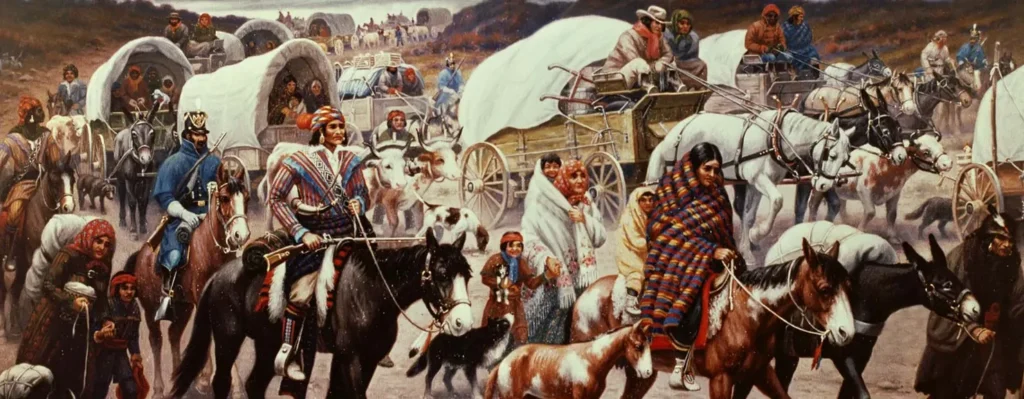
However, the criticisms must be acknowledged. A primary critique involves the human toll on Native Americans: The 1830 Indian Removal Act prompted forced relocations, including the 1838-1839 Trail of Tears, where thousands perished from disease and hardship as tribes were displaced westward.[18] This fueled conflicts like the 1832 Black Hawk War.[19] Wars entailed violence; the Mexican-American War claimed 13,000 U.S. lives and cost $100 million, motivated by territorial ambitions over lightly settled Mexican lands.[20] Overseas expansions, such as the post-1898 Philippine-American War, encountered resistance and significant casualties, prompting imperialism debates. Environmentally, hasty settlement caused overfarming and resource exhaustion in certain regions.[21] Figures like Henry David Thoreau condemned it as aggressive expansion, favoring land over human welfare, while others viewed economic incentives—securing trade and resources—behind the destiny narrative.[22]
In conclusion, Manifest Destiny’s expansions forged a nation of exceptional opportunity, innovation, and strength. From 13 states to a transcontinental powerhouse, it integrated diverse areas, ignited economic booms like the Gold Rush and railroads, and established the United States as a global leader. The benefits outweighed the obstacles, cultivating resilience that characterizes the nation—from Oregon Trail pioneers to Hawaiian strategic outposts. Manifest Destiny represented not mere growth, but a realized vision, shaping America into a symbol of freedom and prosperity.
[1: Treaty of Paris (1783) | National Archives – https://www.archives.gov/milestone-documents/treaty-of-paris] [2: Northwest Ordinance (1787) | National Archives – https://www.archives.gov/milestone-documents/northwest-ordinance] [3: The Northwest Ordinance of 1787 | US House of Representatives – https://history.house.gov/Historical-Highlights/1700s/Northwest-Ordinance-1787/] [4: Louisiana Purchase, 1803 – Office of the Historian – https://history.state.gov/milestones/1801-1829/louisiana-purchase] [5: Lewis and Clark: Expedition, Purpose & Facts | HISTORY – https://www.history.com/topics/lewis-and-clark] [6: United States Population Chart | US History II (OS Collection) – https://courses.lumenlearning.com/suny-ushistory2os2xmaster/chapter/united-states-population-chart/] [7: Acquisition of Florida: Treaty of Adams-Onis (1819) – https://history.state.gov/milestones/1801-1829/florida] [8: Annexation Process: 1836-1845 A Summary Timeline – http://www.tsl.texas.gov/ref/abouttx/annexation/timeline.html] [9: The Oregon Territory, 1846 – Office of the Historian – https://history.state.gov/milestones/1830-1860/oregon-territory] [10: Oregon Trail: Length, Start, Deaths & Map | HISTORY – https://www.history.com/topics/oregon-trail] [11: The Treaty of Guadalupe Hidalgo | National Archives – https://www.archives.gov/education/lessons/guadalupe-hidalgo] [12: The California Gold Rush | American Experience | Official Site – PBS – https://www.pbs.org/wgbh/americanexperience/features/goldrush-california/] [13: Gadsden Purchase, 1853–1854 – Office of the Historian – https://history.state.gov/milestones/1830-1860/gadsden-purchase] [14: Transcontinental railroad completed | May 10, 1869 – History.com – https://www.history.com/this-day-in-history/may-10/transcontinental-railroad-completed] [15: Purchase of Alaska, 1867 – Office of the Historian – https://history.state.gov/milestones/1866-1898/alaska-purchase] [16: Annexation of Hawaii, 1898 – state.gov – https://2001-2009.state.gov/r/pa/ho/time/gp/17661.htm] [17: United States Population Chart | US History II (OS Collection) – https://courses.lumenlearning.com/suny-ushistory2os2xmaster/chapter/united-states-population-chart/] [18: Indian Removal Act: Primary Documents in American History – https://guides.loc.gov/indian-removal-act] [19: Black Hawk War | US-Native American Conflict, 1832 – Britannica – https://www.britannica.com/event/Black-Hawk-War] [20: Mexican-American War Facts, Details, Statistics – https://www.americanhistorycentral.com/entries/mexican-american-war-facts/] [21: Manifest Destiny: The American Dream or an Ecological Crisis? – https://ohiostate.pressbooks.pub/enr3470studentbook/chapter/manifest-destiny-the-american-dream-or-an-ecological-crisis/] [22: Henry David Thoreau in Manifest Destiny & Mexican-American War – https://www.shmoop.com/study-guides/manifest-destiny-mexican-american-war/henry-david-thoreau.html]

