
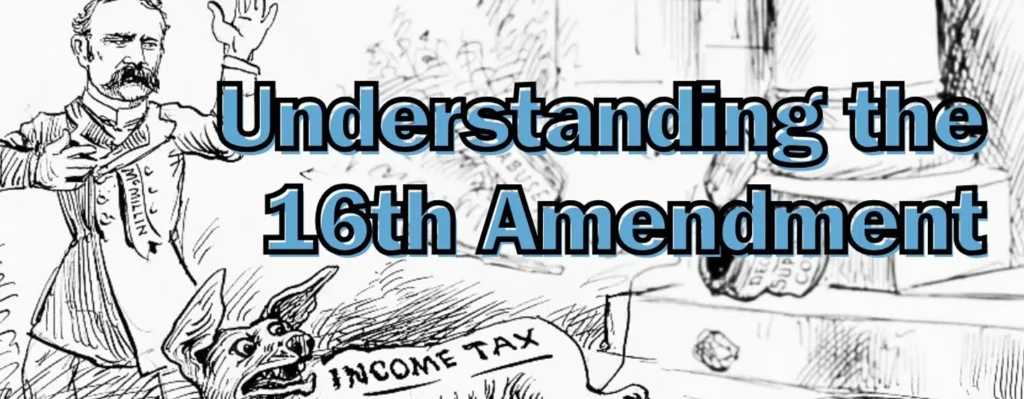
Introduction
Most Americans are required to pay income taxes annually, with failure to file returns to the Internal Revenue Service (IRS) potentially resulting in imprisonment. In the 21st century, taxation extends far beyond income, encompassing sales tax, social security contributions, gasoline taxes, and capital gains taxes, to name a few. However, the income tax remains the most widely recognized form of federal taxation. Tax rates have varied based on income levels throughout history. As of 2025, the rate starts at 10% for incomes up to $11,600 and reaches a maximum of 37% for incomes of $609,351 or more. Since 1913, income tax rates have fluctuated dramatically, peaking at 94% in 1944 for incomes exceeding $200,000.[1]
Before 1913, with the exception of a temporary measure during the American Civil War, the United States had no federal income tax. It was the ratification of the 16th Amendment on February 3, 1913, that authorized Congress to impose such a tax.[2] Ratifying a constitutional amendment requires either two-thirds approval in both the House of Representatives and the Senate, followed by ratification by three-fourths of the states, or a constitutional convention called by two-thirds of state legislatures—the former method was used for the 16th Amendment.[3] In today’s political climate, where income taxes and the IRS face significant unpopularity, passing a similar amendment seems improbable. However, the federal tax system was markedly different a century ago. The 16th Amendment emerged from long-standing political debates over tariffs, which had been one of the most contentious issues in the first 120 years of the nation’s history. It marked the first addition to the U.S. Constitution since the Reconstruction-era amendments 43 years prior.
Pre-1913 Federal Revenue: Reliance on Tariffs and Excise Taxes
Prior to the 16th Amendment’s ratification, the United States primarily funded its operations through tariffs and excise taxes, with the first tariff legislation enacted in 1789.[4] Excise taxes during this era were modest and applied to a limited range of goods, including whiskey, tobacco, rum, and refined sugar. These domestic excise taxes could provoke strong opposition; a notable example is the Whiskey Rebellion of 1791, where western Pennsylvania farmers protested a tax of 6 to 18 cents per gallon on whiskey, intended to repay Revolutionary War debts. Consequently, tariffs became the dominant source of federal revenue, accounting for 90% of government income from 1790 to 1860.
Tariffs served dual purposes: generating revenue and protecting nascent American manufacturing. In 1790, the young nation and its industries were vulnerable to European imports. Alexander Hamilton’s Report on Manufactures, issued that year, advocated for protective tariffs to foster economic independence from foreign powers.[5] The Tariff Act of 1790 introduced protective duties, though rates were relatively low compared to later increases.[6]
Over time, tariffs grew more protective. The War of 1812 prompted significant hikes, with the 1812 tariff doubling duties across the board and adding a 10% surcharge on goods imported via foreign vessels. These measures were temporary, set to expire one year after peace with Great Britain. New England opposed these high tariffs due to their impact on shipping and commerce. Following the Treaty of Ghent, the Tariff of 1816 was enacted as a protective measure aimed at self-sufficiency, though some described it as moderate. The nation then endured a severe depression from 1817 to 1824, attributed not to high tariffs but to the abrupt shift from wartime rates, leading to widespread industrial stagnation and bankruptcies, as noted by former Speaker of the House James Blaine in his book Twenty Years of Congress.[7]
Post-depression, Congress passed the Protective Tariff of 1824, followed by the highly protective Tariff Act of 1828, infamously known as the Tariff of Abominations. This act inflated import costs by up to 50% to shield American industries. It garnered strong support in the North and Midwest but faced fierce opposition in the South, which depended on cotton exports to Britain and feared retaliatory tariffs. Southerners viewed it as enriching Northern manufacturers at the expense of Southern agriculture, allowing unchecked price hikes on essential imports.
The Tariff of 1828 exacerbated regional divides. Previously, tariffs had balanced debt repayment and industrial protection, but this act intensified perceptions of Northern favoritism. A compromise in 1833 gradually reduced rates to 20% by 1842. In a 1859 speech to the House of Representatives, Hon. Alfred Scales of North Carolina voiced Southern frustrations: “Shall I be told that your manufacturers flourished, that the revenues increased, and be asked to take this as evidence of the prosperity of the country during the operation of these high tariff acts? I answer as the south and west might answer ‘your manufacturers have flourished, but at our expense, your revenues for a time increased, but we paid the tax…It is true, a beneficent Providence smiled upon our labors and crowned them with abundant fruits; yet our cotton, our breadstuffs, our tobacco, our other products, were made subservient to the purposes of the manufacturers. Our money was absorbed in the enhanced price of the protected yet necessary article. It was your profit; but not unfrequently drawn from our necessities. We are neglected – Aye, more oppressed by Government. You were pampered and fed by its bounty. Your cities increased in population, wealth, commerce, and ours, like conquered provinces, were made tributary to your greatness.’”[8]
Further adjustments in 1842 and 1846 shifted toward revenue-focused “free-trade” tariffs. The period from 1846 to 1857 was prosperous for manufacturing and agriculture alike.[9] The Tariff of 1857, amending the Walker Tariff of 1846, responded to federal surpluses, with manufacturers not even seeking protective favors.[10] However, the Panic of 1857, lasting until 1861, led to the Morrill Tariff of 1861, a highly protective measure backed by the emerging Republican Party. By its passage, several Southern states had seceded. This context is essential to understanding the push for an income tax amendment, as tariffs’ inequities fueled demands for reform.
The Civil War and the First Federal Income Tax
Amid the Civil War, the North required funds for its war efforts. In 1862, the first federal income tax was enacted, imposing 3% on incomes between $600 and $10,000, and 5% on those exceeding $10,000.[11] Rates increased in 1864: 5% on $600 to $5,000, 7.5% on $5,000 to $10,000, and 10% above $10,000.[12] Additionally, the 1864 tariff raised average rates from 18% to 47.5%. The income tax was repealed seven years after the war’s end in 1872, but the high protective tariffs persisted for over 25 years, with manufacturers arguing they were essential for survival, echoing earlier protectionist strategies from 1828 to 1846.
In 1889, Republicans regained control of the White House, House, and Senate, promising tariff revision. However, the 1890 McKinley Tariff raised average duties on dutiable goods from 47.5% to 60%. Postmaster General John Wanamaker remarked, “Very soon the manufacturers will have their way, and we will have to pay much more.” This policy inadvertently fostered monopolies by barring foreign competition, enabling trusts to dominate markets and stifle small businesses. The McKinley Tariff’s unpopularity contributed to Republican losses, including President Harrison’s defeat, and a Democratic supermajority in the House.
Growing Support for Income Tax and the 1894 Attempt
By the 1890s, as tariffs grew unpopular, public support for a national income tax increased. In 1894, Democrats proposed the Wilson-Gorman Tariff to curb protectionism, lowering rates and exempting items like iron ore, coal, lumber, and wool. Senate amendments diluted reforms, but the act included a 2% income tax on earnings over $4,000—the first peacetime income tax. However, in Pollock v. Farmers’ Loan & Trust Company (1895), the Supreme Court ruled it unconstitutional in a 5-4 decision, deeming it an unapportioned direct tax violating Article I, Section 2, which requires direct taxes to be apportioned by population.[13] The Court distinguished it from excises, noting the Constitution’s clauses on apportionment and congressional taxing powers.
Over the next 15 years, support for an income tax grew, seen as a means to tax wealthy industrialists who benefited from protective tariffs at the public’s expense. Many viewed it as a tool to redistribute wealth from “robber barons.” Even within the Republican Party, divisions emerged over tariffs versus income taxes.
Proposal and Ratification of the 16th Amendment
In 1909, Senator Norris Brown of Nebraska proposed a constitutional amendment: “The Congress shall have power to lay and collect direct taxes on income without apportionment among the several states according to population.” Revised by the Senate Finance Committee, the final text read: “The Congress shall have the power to lay and collect taxes on income, from whatever source derived without apportionment among the several states, and without regard to any census or enumeration.”[14] No explanation was provided for the change. The amendment enjoyed broad support, particularly in the South and West, where high tariffs had disadvantaged regions to benefit Northern manufacturers. Proponents believed it would enable taxation of accumulated wealth.
Opposition came mainly from Northeastern states. Representatives Sereno Payne of New York and others argued income taxes should be limited to wartime. Congressman Ebenezer Hill of Connecticut feared unfair burdens on poorer states. Congressman Samuel McCall of Massachusetts voiced deep concerns: “While they say they desire this for time of war, we see today in times of peace an attempt to exercise this power to its utmost extent. And why not, then limit it expressly to time of war? Why not preserve the limitation upon the power of the Central Government? Why drag every governmental power to Washington so that a vast centralized government may devour the states and the liberty of the individual as well? This amendment should be more carefully considered than it has yet been considered.” He further warned: “it is not primarily to raise money for the state, but to regulate the citizen and to regenerate the moral nature of man. You are creating here an ideal condition for corruption and the political Jack Cade of the future to levy blackmail.”[15] McCall’s predictions on potential abuses proved prescient.
After a five-hour debate, the House passed the amendment on July 12, 1909, by a vote of 318-14, with one “present” and 55 not voting. The Senate approved it unanimously, 77-0.[16] Ratification required three-fourths of the states. Alabama ratified first in August 1909, followed by Kentucky and South Carolina in early 1910. By July 1910, eight states supported it, while eight opposed. By January 1911, Ohio became the tenth to ratify, with most approvals from Southern states. Five states—New York, Rhode Island, Virginia, Massachusetts, and Louisiana—had rejected it.
By March 1911, 26 states had ratified, while 11 opposed or took no action: Louisiana, Massachusetts, New York, Rhode Island, Virginia, Arkansas, New Hampshire, Utah, Vermont, West Virginia, and New Jersey. With Arizona and New Mexico’s impending statehood, 36 ratifications were needed. A key ratification quirk: states could not rescind approvals but could reverse rejections.[17]
Kentucky’s Governor A.E. Wilson, a Republican in a Democratic state, opposed the amendment despite his legislature’s ratification. He argued: “there is a fallacy that with a federal income tax it will be the Rockefellers and Carnegies and other multi-millionaires who will pay for running the government. The poor man does not regard his wages or salary as income. The sixteenth amendment gives congress the power to levy a tax on profits of farms, factories, stores, on the earnings of all men and women in whatever work or calling, and on all other kinds of income.” He added: “under our present system of taxation, it is the mass of people who bear the burden, not the multi-millionaires. Under a federal income tax the same condition would exist.” Wilson feared it would erode state powers, as federal taxation would drain resources needed locally, and layering state taxes would face resistance. He also predicted unchecked congressional spending: “There are hundreds of men in public life wormy with schemes to spend money and provide jobs for henchmen. One man is thinking irrigation, another of a transcontinental railroad in San Francisco, another of an Appalachian Reserve, another of a national park in the White Mountains. Every new chance to raise additional revenues is another opportunity to get one of these schemes through and bunches of jobs with them.” Additionally, the phrase “from whatever source derived” could enable taxation of state officials and bonds, further weakening states. If intended for wartime, he urged explicit limitation. Wilson’s warnings on bureaucratic growth and abuse were forward-looking, but Kentucky’s legislature ignored him, and he lost re-election.
Throughout 1911, more states ratified: Maine in late March, Tennessee shortly after, and Arkansas reversed its rejection, bringing totals to 25 approvals and 10 oppositions. Massachusetts rejected in May. By July, 31 states had ratified, including a reversed New York. After a 10-month lull, Arizona ratified in April 1912. The year ended with 34 ratifications. In January 1913, West Virginia reversed and approved. On February 3, 1913, Delaware became the 36th state to ratify, making the amendment official—coinciding with New Mexico and Wyoming’s ratifications, followed by New Jersey the next day.[18] This was the first amendment since the 15th in 1870, prohibiting voting restrictions based on race, color, or prior servitude.[19]
Post-Ratification Developments and Tax Rate Evolution
The political landscape shifted around ratification. Woodrow Wilson, inaugurated in 1913, won amid Republican splits over tariffs, with Teddy Roosevelt’s third-party run dividing votes; Wilson secured 42%. Democrats favored progressive income taxes and tariff reductions. The Revenue Act of 1913, or Underwood Tariff/Underwood-Simmons Act, lowered average tariffs from 40% to 27% and added a “free list” for items like raw wool, cattle, sheep, wheat, eggs, meat, iron ore, pig iron, coal, and lumber.[20] It imposed the first peacetime income tax since the Civil War: 1% on incomes above $3,000 ($4,000 for joint filers), maxing at 7% above $500,000.[21] Assessing the act’s impact is complex; goods prices fell, but World War I reduced imports while boosting exports.
From 1913 to 1916, rates remained low, affecting about 2% of the population. In 1916, the Revenue Act raised the base to 2% and the top to 15% above $2 million, with 7% applying above $100,000.[22] U.S. entry into World War I in 1917 prompted sharp increases: 2% to 67% above $2 million, affecting roughly 5% of the population. In 1918, the top rate hit 77% above $1 million. Tax revenue surged from $809 million in 1917 to $3.6 billion in 1918, funding one-third of the war. The Federal Reserve’s 1913 creation contributed to dollar devaluation, gradually pushing more Americans into taxable brackets.
Post-World War I, rates declined, bottoming at 25% above $100,000 in 1925, stable through the 1920s. The Great Depression prompted the 1932 Revenue Act, raising the top to 63% above $1 million and 56% above $100,000 (from 25%). Rates rose further, peaking at 79% during the Depression. World War II brought the “Victory Tax” in 1942, hiking the top to 88% above $200,000 and the base to 19%, with exemptions of $500 single/$1,200 married. By 1945, it reached 94% above $200,000. By war’s end, 90% of Americans filed returns, up from 1% in 1913.
In the 1950s, the top rate stayed at 91% above $200,000. Reductions began in the 1960s, with top rates fluctuating between 30% and 40% since the 1990s.[23] Factors like filing status and exemptions influence effective rates. Tariffs persisted post-1913; the Fordney-McCumber Act of 1922 raised averages to 40%, and Smoot-Hawley in 1930 to nearly 20%. Post-World War II, tariffs dropped to 1.4%–2.9%, shifting toward free trade.
Historical Context and Impacts
Before 1913, revenue came mainly from tariffs and occasional excise or land taxes for wars like the Quasi-War, War of 1812, 1816, and Civil War. Tariffs were often protective, though periods like the 1846 Walker Tariff (averaging 22%) were revenue-oriented.[24] Protectionists warned of industrial collapse without high tariffs, but as former Senator Charles Schurz noted, the Walker era saw gradual manufacturing growth through innovation, not sudden booms, with foreign competition spurring improvements.[25] James Blaine described post-1846 prosperity: “The tariff of 1846 was yielding abundant revenue, and the business of the country was in a flourishing condition. Money became very abundant after the year 1849; large enterprises were undertaken, speculation was prevalent, and for a considerable period the prosperity of the country was general and apparently genuine.”[26] Manufacturers thrived without protection, not seeking favors by 1856. High-tariff periods fostered dependency, despite evidence that sound business practices sufficed amid competition. Surpluses occasionally arose, including in 1912, the year before ratification.
A major consequence of the 16th Amendment was the erosion of states’ rights and power, accelerating since the Civil War. Samuel McCall opposed it, predicting centralization: “Why drag every governmental power to Washington so that a vast centralized government may devour the states and the liberty of the individual as well.”[27] Before 1913, income and corporate taxes were state prerogatives. Today, federal taxes overshadow state ones, with the government sometimes withholding funds to influence policy, as in 1996 when Louisiana faced highway funding cuts over its drinking age ruling. McCall also foresaw regulation over revenue: “it is not primarily to raise money for the state, but to regulate the citizen and to regenerate the moral nature of man.” As of 2022, the U.S. Tax Code spans 6,871 pages, with regulations and guidance totaling about 75,000 pages, imposing complex burdens and enabling political targeting.
Governor A.E. Wilson similarly warned that it would burden the masses, not just the wealthy: the poor would not escape, as wages qualify as income. Initially affecting 1-2%, by the 1940s, 90% filed returns; today, about 60% of households pay income taxes, with many non-payers on welfare, heightening taxpayer burdens. Wilson predicted state power loss and federal extravagance: “Give congress the right to tax, and congress will use it… Every new chance to raise revenues is another opportunity to get one of these schemes through and bunches of jobs with them.”[28] Federal civilian employees numbered around 380,000 in 1910 (up from 231,000 in 1901); by the 2020s, over 2 million. Paired with the Federal Reserve, this has fueled unchecked spending and bureaucracy, diminishing state autonomy.
Though conceived to replace monopolistic tariffs with equitable taxation, the 16th Amendment became a powerful federal tool. Governor Wilson’s insights on its implications remain strikingly relevant.
[1] Here’s the Start of Your Tax Troubles – Graphic – NYTimes.com – https://www.nytimes.com/interactive/2013/02/11/your-money/Heres-the-Start-of-Your-Tax-Troubles.html?_r=1
[2] Happy Centennial, Federal Income Tax – The New York Times – https://archive.nytimes.com/economix.blogs.nytimes.com/2013/10/01/happy-centennial-federal-income-tax/
[3] The Article V Convention for Proposing Constitutional Amendments – https://www.congress.gov/crs_external_products/R/PDF/R42592/R42592.9.pdf
[4] A B C’S OF THE TARIFF: A HISTORIC U. S. ISSUE; Congress Will … – https://www.nytimes.com/1955/01/16/archives/a-b-cs-of-the-tariff-a-historic-u-s-issue-congress-will-take-up.html
[5] Alexander Hamilton’s Final Version of the Report on the Report on Manufactures – https://founders.archives.gov/documents/Hamilton/01-10-02-0001-0007
[6] A B C’S OF THE TARIFF: A HISTORIC U. S. ISSUE; Congress Will … – https://www.nytimes.com/1955/01/16/archives/a-b-cs-of-the-tariff-a-historic-u-s-issue-congress-will-take-up.html
[7] Twenty years of Congress: from Lincoln to Garfield. With a review of … – https://repository.wellesley.edu/_flysystem/fedora/2024-01/WCSC_Elbert_twentyyearsofcon001blai.pdf
[8] CONGRESSIONAL RECORD-SENATE. – Congress.gov – https://www.congress.gov/53/crecb/1894/05/29/GPO-CRECB-1894-pt6-v26-8.pdf
[9] The Writings of Carl Schurz/The Tariff Question – Wikisource – https://en.wikisource.org/wiki/The_Writings_of_Carl_Schurz/The_Tariff_Question
[10] The Writings of Carl Schurz/The Tariff Question
[11] Historical Highlights of the IRS | Internal Revenue Service – https://www.irs.gov/newsroom/historical-highlights-of-the-irs
[12] Theme 2: Taxes in U.S. History – Lesson 3: Income Tax Issues – IRS – https://apps.irs.gov/app/understandingTaxes/student/whys_thm02_les03.jsp
[13] “Constitutional Amendments” Series – Amendment XVI – “Income … – https://reagan.blogs.archives.gov/2022/09/20/constitutional-amendments-series-amendment-xvi-income-taxes/
[14] 1909. CONGRESSIONAL RECORD-HOUSE. – Congress.gov – https://www.congress.gov/61/crecb/1909/07/12/GPO-CRECB-1909-pt4-v44-21.pdf
[15] 1909. CONGRESSIONAL RECORD-SENATE. – Congress.gov – https://www.congress.gov/60/crecb/1909/02/10/GPO-CRECB-1909-pt3-v43-4.pdf
[16] 1909. CONGRESSIONAL RECORD-HOUSE. – Congress.gov – https://www.congress.gov/61/crecb/1909/07/12/GPO-CRECB-1909-pt4-v44-21.pdf
[17] 1909. CONGRESSIONAL RECORD-HOUSE. – Congress.gov – https://www.congress.gov/61/crecb/1909/07/12/GPO-CRECB-1909-pt4-v44-21.pdf
[18] Amending the Constitution: 100 Days to 200 Years – Pieces of History – https://prologue.blogs.archives.gov/2013/09/17/amending-the-constitution-100-days-to-200-years/
[19] The Constitution: Amendments 11-27 | National Archives – https://www.archives.gov/founding-docs/amendments-11-27
[20] Happy Centennial, Federal Income Tax – The New York Times
[21] Here’s the Start of Your Tax Troubles – Graphic – NYTimes.com
[22] Once Cut, Corporate Income Taxes Are Hard to Restore – https://www.nytimes.com/2018/06/22/business/big-war-to-raise-the-corporate-income-tax.html
[23] An Economic Analysis of the Top Tax Rates Since 1945 – https://graphics8.nytimes.com/news/business/0915taxesandeconomy.pdf
[24] The Writings of Carl Schurz/The Tariff Question
[25] The Writings of Carl Schurz/The Tariff Question
[26] Twenty years of Congress: from Lincoln to Garfield
[27] 1909. CONGRESSIONAL RECORD-SENATE
[28] Willson, A. E. (1911, February 26). Gov. A.E. Willson on the Income Tax Amendment. The New York Times. https://www.nytimes.com/1911/02/26/archives/gov-ae-willson-on-the-income-tax-amendment.html
