
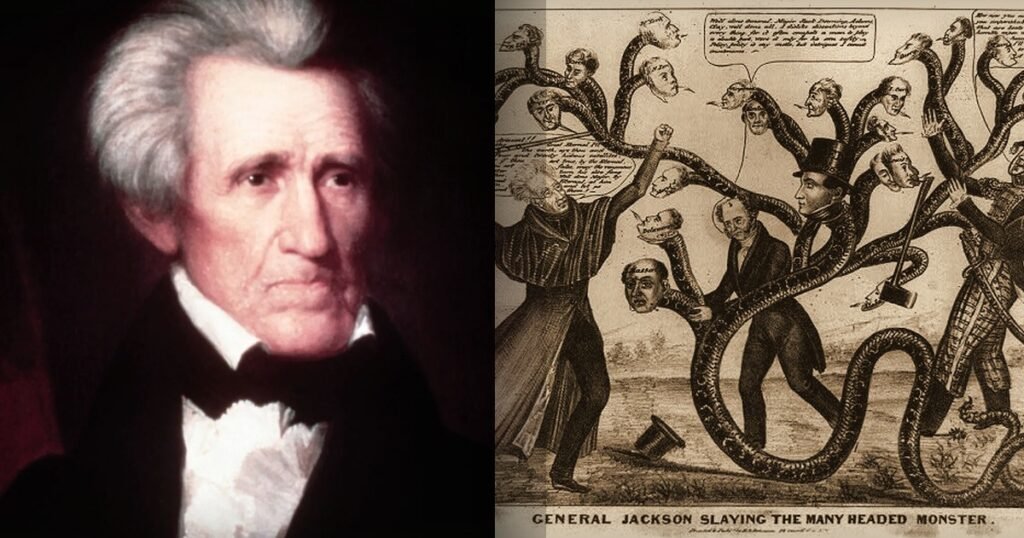
The same playbook the Federal Reserve uses today—concentrated power, political influence, and the quiet transfer of wealth—was written nearly two centuries ago. One man saw it clearly and decided to destroy the institution that embodied it. His name was Andrew Jackson. He would go on to defeat the National Bank in the Bank War
The Second Bank of the United States
Its Purpose
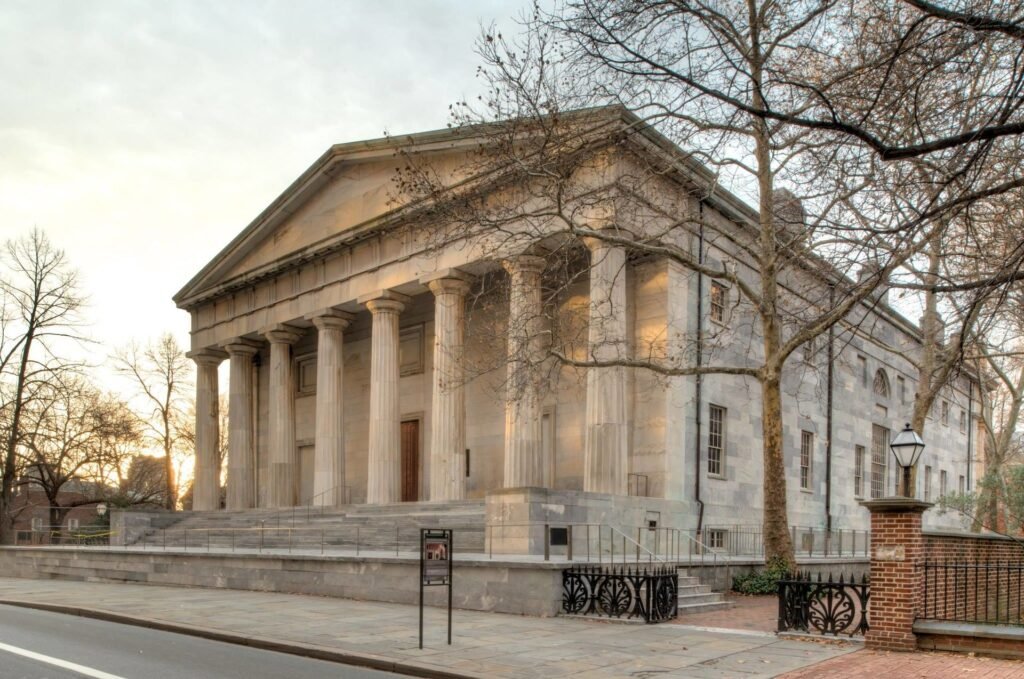
Congress chartered the Second Bank of the United States in 1816, shortly after the War of 1812. Several factors led to Second Bank, but because of the war, the United States authorized the suspension of specie payments due to poor banking practices (for a more in depth analysis, refer to our article “The Complete History of the Federal Reserve, here). President James Madison was opposed to a Central Bank. But, with the situation getting out of hand, he folded. On paper, the institution made sense. It would hold federal deposits, issue a more uniform currency, restrain inflation, and serve as a fiscal agent for the government.
The Reality
In practice, it was a private corporation operating under a government charter. The federal government owned one-fifth of the stock and appointed five of the twenty-five directors. The remaining four-fifths belonged to private stockholders who elected the rest of the board.
By the late 1820s the Bank’s president, Nicholas Biddle, exercised enormous influence over the American economy. The Bank held the federal government’s tax revenues, extended loans, and could expand or contract credit across the country through its network of branches. There was one major issue: there was no oversight over the loans, and many of them were large, nonperforming, and made to insiders and friends. Because of this, the Bank was near bankruptcy just two years into its existence.
The Big Picture
Jackson and his supporters saw the bigger problem. The Bank concentrated financial power in the hands of a relatively small group of wealthy investors, many of them concentrated in the Northeast. A significant share of the stock—more than a fourth, according to Jackson—was held by foreigners, primarily British investors. The rest was largely controlled by a few hundred of the richest American citizens. Members of Congress and other political figures received favorable loans from the Bank, creating obvious conflicts of interest. Biddle used the institution’s resources to reward allies, pressure state banks that competed with it, and influence the press.
Nicholas Biddle and the Machinery of Influence
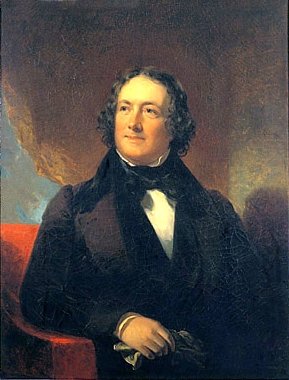
Biddle was brilliant, confident, and deeply convinced of the Bank’s necessity. He could force state banks to redeem their notes in specie (gold or silver) on short notice, draining their reserves and sometimes driving them into failure. He extended easy credit to political friends and tightened it against opponents. The Bank’s money helped shape newspaper coverage and political campaigns. In the eyes of its critics, the Second Bank had become a private government with public money at its disposal.
Jackson entered the presidency in 1829 already hostile to the institution. In his first annual message to Congress, he openly questioned whether the Bank should be rechartered when its term expired in 1836. That early signal alarmed Biddle and the Bank’s political allies. They responded by pushing for an early recharter in 1832, calculated to force Jackson’s hand in an election year. Henry Clay, then preparing his own presidential campaign, led the effort in Congress. The recharter bill passed and landed on Jackson’s desk in the summer of 1832.
Jackson’s Veto
Andrew Jackson vetoed the bill on July 10, 1832. His message remains one of the most forceful documents in American political history. He declared the Bank unconstitutional, a monopoly that favored the wealthy and foreigners at the expense of ordinary citizens, and a threat to republican government. One passage has echoed for generations:
“It is to be regretted that the rich and powerful too often bend the acts of government to their selfish purposes.”
Jackson pointed out that more than a fourth of the Bank’s stock was held abroad and that the remainder rested with a narrow class of the richest Americans. He argued that exclusive privileges granted by Congress made the rich richer and the potent more powerful while the farmers, mechanics, and laborers received no such favors. The veto was sustained. Congress could not override it.
Andrew Jackson then took the issue to the voters. In the election of 1832 he crushed Clay, winning 219 electoral votes to Clay’s 49. The people, at least as measured by that contest, sided with the president against the Bank.
Biddle’s Counterattack
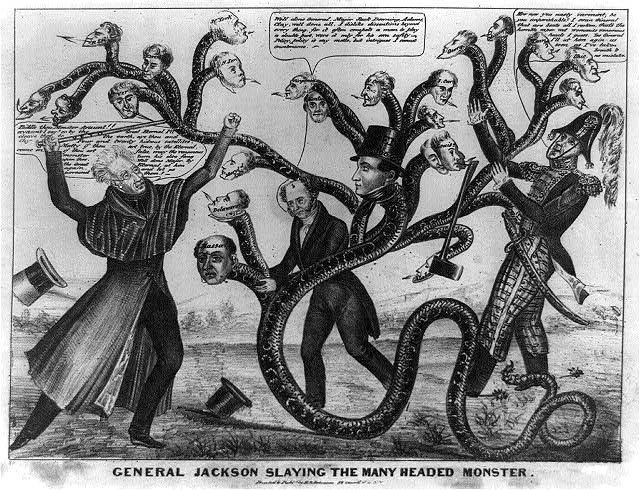
The Bank’s charter still had four years to run. Biddle responded by deliberately contracting credit. He called in loans, restricted new lending, and reduced the circulating medium. The resulting pressure produced a sharp recession in 1833–1834. Businesses failed, and unemployment rose. Biddle’s intention was transparent: to demonstrate that the country could not function without the Bank and to force political pressure on Jackson.
In a letter written in February 1834, Biddle made his attitude toward the president unmistakable: “This worthy President thinks that because he has scalped Indians and imprisoned Judges, he is to have his way with the Bank. He is mistaken.” The remark captured both Biddle’s arrogance and the personal nature of the conflict.
Removing the Deposits
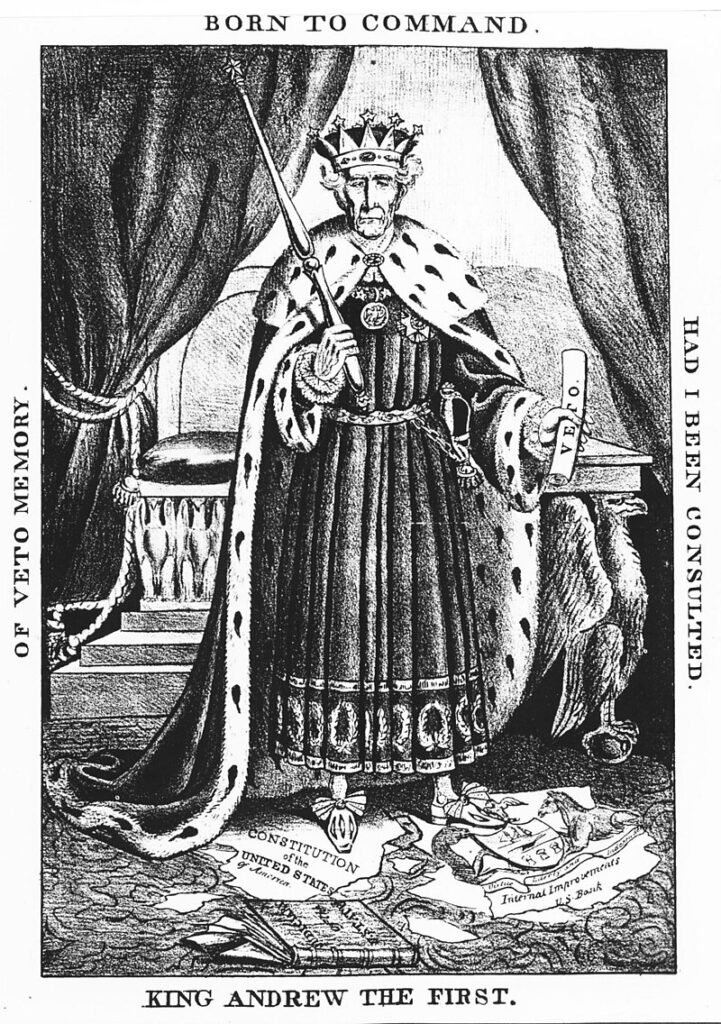
Jackson answered by ordering the removal of federal deposits from the Bank. The law required the Secretary of the Treasury to issue the order. When William J. Duane refused, Jackson dismissed him and appointed Roger B. Taney, who carried out the removal. The funds were placed in selected state banks—derisively labeled “pet banks” by opponents.
Jackson planned to eventually create the Independent Treasury System to store funds. This came to fruition under Martin Van Buren. However, the Whigs repealed the Independent Treasury System. Polk reestablished the Independent Treasury System in 1846, and it remained the foundation of federal fiscal management for decades. Lincoln’s Civil War policies, however, heavily transformed the banking system through the National Banking Acts and the issuance of greenbacks, significantly diminishing the ITS’s original independence from private banks.
The Senate Attacks Jackson
The Senate, controlled by Bank allies including Clay and Daniel Webster, responded with an unprecedented formal censure of the president on March 28, 1834. The resolution declared that Andrew Jackson had “assumed upon himself authority and power not conferred by the Constitution and laws, but in derogation of both.” It remains the only time the Senate has formally censured a sitting president. Jackson protested vigorously. The censure was later expunged from the Senate Journal in 1837 after Democrats regained control.
When the Bank’s charter expired in 1836, the Second Bank of the United States ceased to exist as a national institution. Jackson had killed it.
The Panic of 1837 and the Legacy
The economy did not remain calm. The Panic of 1837 produced widespread bank failures, collapsing land prices, and severe hardship. Critics immediately blamed Jackson’s destruction of the Bank. The reality was more complicated. Multiple forces converged: the Bank of England’s decision to raise interest rates and restrict credit, which pulled British capital out of American investments; Jackson’s Specie Circular of 1836, which required payment for public lands in gold or silver and helped puncture a speculative land bubble; and the subsequent expansion of poorly regulated state “wildcat” banks that issued notes with insufficient backing.
Historians still debate the relative weight of these factors. What is clear is that removing one concentrated and politically entangled institution did not automatically produce a stable alternative. The corruption and speculative excesses Jackson fought simply migrated into new forms.
Different Bank, Same Corruption
Seventy-seven years later, in November 1910, a small group of bankers and politicians met in secret at the Jekyll Island Club off the coast of Georgia. The plan they drafted became the foundation of the Federal Reserve System. The names and institutional details changed. The underlying tension between concentrated financial power and democratic accountability did not.
Jackson remains the only American president who successfully dismantled a central bank. Whether that victory protected the republic or merely delayed the return of a more permanent version of the same system is still an open question. The arguments he made in 1832—about privilege, foreign influence, political corruption, and the tendency of the powerful to bend government to their purposes—have not lost their force.
When will we get a modern-day Andrew Jackson to wage war against the Federal Reserve? The Federal Reserve has far outlasted both the First and Second National Bank. Unfortunately, it does not seem likely.
Notes
- Murray N. Rothbard, A History of Money and Banking in the United States: The Colonial Era to World War II, ed. Joseph T. Salerno (Auburn, AL: Ludwig von Mises Institute, 2002). Rothbard provides a detailed Austrian-school analysis of the First and Second Banks of the United States, Jackson’s Bank War, the subsequent free-banking era, the National Banking System, and the origins of the Federal Reserve.
- G. Edward Griffin, The Creature from Jekyll Island: A Second Look at the Federal Reserve (Westlake Village, CA: American Media, 1994; later editions available). A widely read popular account of the Jekyll Island meeting and the creation of the Federal Reserve.
- Bray Hammond, Banks and Politics in America from the Revolution to the Civil War (Princeton: Princeton University Press, 1957); Federal Reserve History, “The Second Bank of the United States.”
- Ibid.; Andrew Jackson, Veto Message Regarding the Bank of the United States, July 10, 1832, Avalon Project, Yale Law School.
- Robert V. Remini, Andrew Jackson and the Bank War (New York: W.W. Norton, 1967); Miller Center, University of Virginia, “The Bank War.”
- Jackson, Veto Message, July 10, 1832.
- Minneapolis Federal Reserve, “The Rise and Fall of Nicholas Biddle” (2008); contemporary accounts of Biddle’s correspondence.
- U.S. Senate Historical Office, “Senate Censures President,” March 28, 1834.
- Peter Temin, The Jacksonian Economy (New York: W.W. Norton, 1969); standard economic histories of the Panic of 1837
