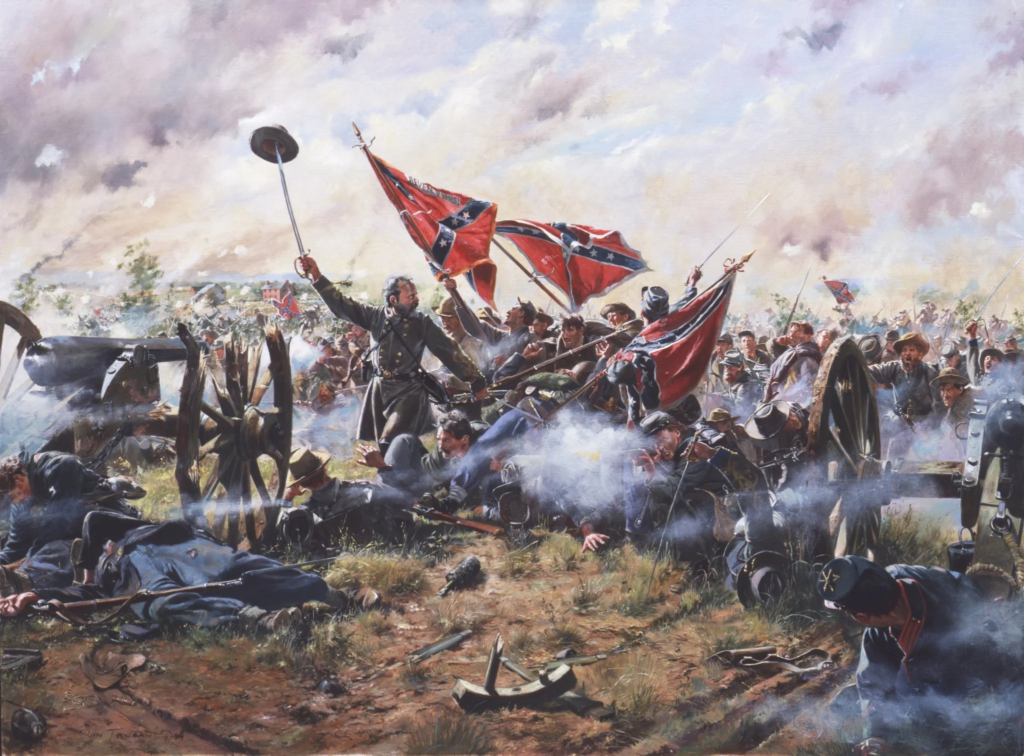
On the afternoon of July 3, 1863, more than 12,500 Confederate soldiers stepped out of the treeline on Seminary Ridge near Gettysburg, Pennsylvania. Arrayed in disciplined lines with bayonets fixed and battle flags flying, they advanced across nearly three-quarters of a mile of open farmland toward the Union center on Cemetery Ridge. Fences, the Emmitsburg Road, and a deadly combination of artillery and rifle fire awaited them. This assault became known as Pickett’s Charge.
The assault on Cemetery Ridge represented Robert E. Lee’s attempt to shatter the Union center, split the Army of the Potomac, and potentially decide the Battle of Gettysburg and the Civil War in a single bold stroke. While it is often called the “High Water Mark of the Confederacy,” the charge has been debated for generations as either a courageous necessity born of strategic desperation or one of the greatest tactical blunders in American military history.
Background: Why Lee Invaded the North
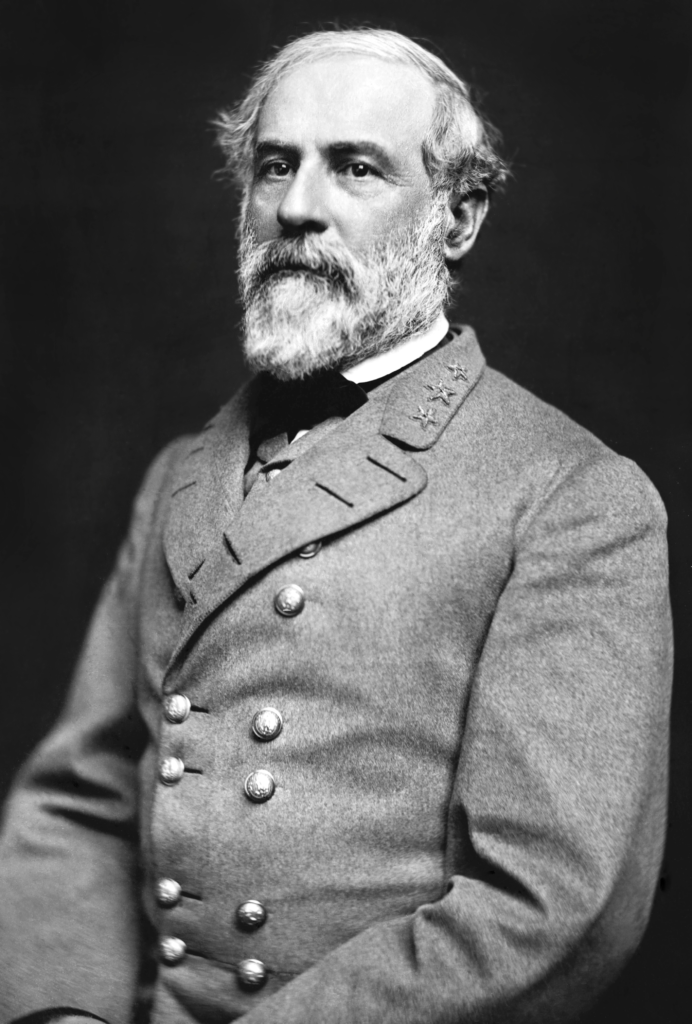
By the summer of 1863, the American Civil War had raged for more than two years. Meanwhile, the Confederacy was fighting for survival, but Virginia—the heart of the South—had been devastated by Union armies. Farms were destroyed, towns burned, and resources depleted.
Robert E. Lee, commanding the Army of Northern Virginia, had just achieved a stunning victory at Chancellorsville in May 1863. Outnumbered more than two to one, he split his army, flanked Maj. Gen. Joseph Hooker’s force, and drove it from the field in what many regard as his greatest tactical masterpiece. The triumph, however, came at an irreplaceable cost: the mortal wounding of Lt. Gen. Thomas “Stonewall” Jackson by friendly fire on the night of May 2. Jackson died eight days later. Lee later remarked that he had lost his “right arm.”
Lee’s Dilemma
Lee understood that the South could not win a prolonged war of attrition. The Confederacy was an agrarian society with few factories, a sparse free population, limited railroads, and an economy built largely on cotton. The North possessed booming industry, a much larger population continually augmented by immigration, superior manufacturing capacity, and growing naval power that enforced a tightening blockade. Every month of continued fighting widened the disparity in men, material, and political endurance.
Lee’s answer was to take the war north. In June 1863, he led the Army of Northern Virginia into Pennsylvania, intending to live off Northern farms, threaten cities such as Washington or Philadelphia, boost Southern morale, and land a decisive blow that might shatter Northern will to continue the war—or even draw Britain or France into recognition of the Confederacy.
By late June the Confederate army was spread across Pennsylvania. Almost by accident, the two armies collided at the crossroads town of Gettysburg on July 1.
The Battle So Far: Days 1 and 2
Day 1

Day 1 of Gettysburg favored the Confederates. Confederate infantry seeking supplies encountered Union cavalry under Brig. Gen. John Buford, who delayed them long enough for Union infantry to occupy the high ground south of town. However, the Confederates pushed Union forces back through Gettysburg, inflicting heavy losses, but the Federals retired to strong positions on Cemetery Hill, Cemetery Ridge, and Culp’s Hill, forming a defensive “fishhook” line. Lee held the initiative; the Union held the terrain.
Day 2
Conversely, on Day 2 of the battle, Lee attacked both Union flanks simultaneously. Lt. Gen. James Longstreet’s corps struck the Union left through Devil’s Den, the Wheatfield, and the Peach Orchard in some of the war’s fiercest close-quarters fighting. On the extreme left, the 20th Maine under Col. Joshua Chamberlain held Little Round Top with a desperate bayonet charge after exhausting its ammunition. On the Union right, fighting raged on Culp’s Hill into the night.
Despite heavy pressure, the Union line held everywhere. Lee concluded that two days of assaults on the flanks must have weakened the center on Cemetery Ridge. He prepared a knockout blow for July 3.
Longstreet’s Opposition
Longstreet, Lee’s senior subordinate and the man Lee called his “Old War Horse,” vehemently disagreed. He urged a maneuver around the Union left to place the Confederate army between the Army of the Potomac and Washington, forcing Maj. Gen. George G. Meade to attack on the ground of the Confederates’ choosing. Lee rejected the proposal. “The enemy is there,” he said, pointing to Cemetery Ridge, “and I am going to attack him there.”
Planning the Assault: Forces and Opposition
Confederate Forces

Lee assigned the main effort to Maj. Gen. George Pickett’s fresh division of approximately 5,400 Virginians—the only major Confederate division not yet heavily engaged at Gettysburg. Pickett’s three brigades were led by Brig. Gens. Richard Garnett, Lewis Armistead, and James Kemper. Supporting on the left were elements of Brig. Gen. James Johnston Pettigrew’s division (from A.P. Hill’s Third Corps, already bloodied on Day 1 after Henry Heth was wounded). Behind them marched two brigades under Maj. Gen. Isaac Trimble (from Dorsey Pender’s division). On Pickett’s right, Brig. Gens. Cadmus Wilcox and David Lang provided additional support. Total strength for the assault was roughly 12,500 men. Longstreet held overall command of the effort.
Union Forces
Opposing them stood Maj. Gen. Winfield Scott Hancock’s II Corps, veteran troops firmly anchored behind a low stone wall on Cemetery Ridge, with artillery covering both flanks from elevated ground. The plan was straightforward and terrifying: a massive preliminary artillery barrage to silence or suppress the Union guns and infantry, followed by a coordinated infantry advance straight across the open fields to seize the ridge and split the Union army.
Longstreet’s Plea to Lee
Longstreet’s opposition was blunt and personal. He later recounted telling Lee: “General, I have been a soldier all my life. I have been with soldiers engaged in fights by couples, by squads, companies, regiments, divisions, and armies, and should know, as well as any one, what soldiers can do. It is my opinion that no fifteen thousand men ever arrayed for battle can take that position.” Lee listened and ordered the attack anyway. Longstreet later described July 3 as the saddest day of his life.
The Absence of the Confederate Cavalry
Compounding the difficulties was the absence of Lee’s cavalry. Maj. Gen. J.E.B. Stuart, the army’s eyes and ears, had ridden off on a raid around the Union army on June 25 and did not rejoin Lee until the evening of July 2. For roughly ten days, Lee operated with incomplete intelligence on Union strength and dispositions along Cemetery Ridge. That gap reinforced his belief that the center was more vulnerable than it actually was.
The Artillery Barrage: The Largest in North American History

The morning of July 3 was eerily quiet. Around 1 p.m., Col. Edward Porter Alexander—Longstreet’s trusted young artillery chief—orchestrated between 150 and 170 Confederate guns stretching more than two miles along Seminary Ridge. It was the largest artillery barrage yet seen on the North American continent. For nearly two hours, the guns roared; the concussion was reportedly felt as far as Philadelphia, ninety miles away.
Artillery Duel
Union artillery chief Brig. Gen. Henry J. Hunt conserved ammunition and did not reply immediately. After 15–20 minutes, roughly 80 Union guns opened fire. The duel was intense, but many Confederate shells overshot their targets. Poorly manufactured fuses caused a significant number of rounds to sail over Cemetery Ridge and land harmlessly in the rear, killing horses, wrecking wagons, and striking officers behind the lines while leaving the infantry sheltered behind the stone wall largely intact.
When Union fire slackened around 2:45 p.m. as Hunt deliberately ordered a pause to conserve rounds and deceive the enemy, Alexander believed the barrage had succeeded. Around 3 p.m. he sent the urgent message: “For God’s sake come quick.” Longstreet, still reluctant, finally nodded. The infantry rose.
The Charge: Marching into the Fire
Approximately 12,500 Confederates stepped out in near-perfect order—lines dressed as if on parade. Pickett rode along his Virginians: “Up, men, and to your posts! Don’t forget today that you are from Old Virginia!” The men cheered. They advanced under a hot, humid July sun (temperatures around 87°F) across open fields.
Fences slowed them. At the Emmitsburg Road—a sunken lane bordered by post-and-rail fencing that cut diagonally across their path—soldiers had to stop, tear down obstacles, cross the road, and reform under direct fire. Union artillery opened with solid shot, shell, and then deadly canister and grapeshot. Rifles cracked from behind the stone wall. Gaps tore through the ranks. Pettigrew’s men on the left drifted right under enfilading fire from Cemetery Hill. Pickett’s Virginians angled left toward a copse of trees. Men fell by the hundreds, yet the survivors pressed on with remarkable discipline.
High Tide at The Angle

By about 3:30 p.m. the remnants reached the stone wall at a sharp angle in the Union line—the famous “Angle.” Brig. Gen. Lewis Armistead, hat jammed on the point of his sword so his men could see him through the smoke, led the final surge: “Follow me!” A few hundred Confederates—Virginians and others—breached the wall in hand-to-hand fighting. Armistead reached a Union cannon, placed his hand on it, and was mortally wounded by multiple shots. This deepest penetration of Confederate forces into Union territory during the entire war became known as the High Water Mark of the Confederacy.
There was no breakthrough. Union reserves poured in. Hancock’s men counterattacked. The right-flank supports under Wilcox and Lang advanced too late and too weakly. By 3:45–4 p.m. the assault had collapsed. The shattered remnants streamed back across the fields they had just crossed.
The Human Cost of Pickett’s Charge: Armistead, Garnett, and Kemper
Pickett’s three brigade commanders personified the charge’s human toll.
Brigadier General Lewis Armistead

Lewis Armistead, 46, was a career U.S. Army officer and a Virginian. His closest friend for seventeen years had been Winfield Scott Hancock. The two had served together across the Southwest and California. When Virginia seceded, Armistead chose the Confederacy. At an emotional farewell gathering in Los Angeles in 1861, Armistead, tears streaming, placed his hands on Hancock’s shoulders and said, “Hancock, goodbye; you can never know what this has cost me.”
He left a prayer book for Hancock’s wife, Almira, inscribed “Trust in God and fear nothing.” On July 3, Armistead led his brigade over the wall at the Angle toward the position his best friend was defending. He fell just yards inside the Union line. As he was carried to a Union field hospital he asked about Hancock and learned his old friend had also been wounded (a bullet through the thigh). Armistead reportedly wept. He died on July 5 still in Union hands.
Brigadier General Richard Garnett

Richard Garnett carried a heavier burden. In March 1862, while commanding the Stonewall Brigade at the First Battle of Kernstown, he ordered a withdrawal when ammunition ran low and the brigade faced overwhelming numbers. Stonewall Jackson arrested him for neglect of duty and preferred charges. A court-martial convened in August 1862 but was never completed because of subsequent campaigning; the proceedings were suspended and never resumed.
Garnett spent the following year with his honor under a cloud. At Gettysburg, he suffered a severe leg injury from a horse kick and could not walk easily. Infantry commanders were expected to lead on foot, yet Garnett insisted on riding a conspicuous black horse into the assault, making himself an unmistakable target. Fellow officers begged him not to. He was killed somewhere in the final advance; his body was never recovered and was buried in a mass grave. His exact resting place remains unknown.
Brigadier General James Kemper

James Kemper commanded Pickett’s right brigade. He was shot through the upper thigh just short of the stone wall, a wound so severe it nearly killed him. Captured and treated in a Union field hospital, he was later recovered by Confederate forces during the July 4 withdrawal. The wound never fully healed; he walked with difficulty and lived with chronic pain for the rest of his life. Yet he survived.
In 1874 he was elected governor of Virginia—the first former Confederate general to serve as a state governor after the war—and helped rebuild his state in the years that followed.
Pickett’s Officers
Of Pickett’s thirteen regimental commanders, every one was killed or wounded. Pickett’s division alone suffered more than 2,600 casualties. Pettigrew and Trimble lost thousands more. Total Confederate losses in the charge approached 6,000–7,000 killed, wounded, or captured—nearly half the attacking force.
The Aftermath of the Assault: The Cost and the Retreat
Following Pickett’s Charge, Lee rode out to meet the returning survivors and told them, “All this has been my fault. It is I who have lost this fight.” He repeatedly accepted responsibility: “It is all my fault.” When he ordered Pickett to reform his division in case of a Union counterattack, Pickett replied, “General Lee, I have no division now.”
Meade and the Army of the Potomac
Meade’s Army of the Potomac had also been bloodied—more than 23,000 total casualties over three days—but held the field. Exhausted, with extended supply lines and imperfect knowledge of Confederate losses, Meade did not pursue aggressively. He has been criticized ever since, including by President Lincoln, yet he had assumed command of the army only three days before the battle began.
Lee began his withdrawal from Gettysburg toward Virginia on July 4 in pouring rain. That same day, Vicksburg fell to Ulysses S. Grant, delivering a second devastating blow. The Army of Northern Virginia would fight on for nearly two more years, but it never again possessed the strength or strategic position to invade the North.
Was Pickett’s Charge a Blunder? Lee’s Gamble Explained
Tactical Failure
From a purely tactical standpoint, the criticism of Lee is strong and largely justified. The assault crossed open ground against a prepared position backed by superior artillery on the flanks. Longstreet had warned that it was impossible.
The preliminary barrage failed to suppress the Union infantry or silence the guns. Coordination of supporting brigades was imperfect, and no adequate reserve existed to exploit any temporary breach. Frontal assaults of this nature against prepared defenses rarely succeeded without overwhelming firepower or genuine surprise—neither of which was present.
The Strategic Picture
Strategically the picture is more complex. The Confederacy could not win a war of attrition. The Union’s population and industrial base would eventually grind the South down. Lee believed only a decisive victory on Northern soil could shatter Union morale, influence Northern elections, or bring European intervention.
Longstreet’s preference for maneuver and defensive warfare was militarily sound but, in Lee’s view, strategically insufficient to end the war on favorable terms. Lee’s aggressive style had produced victories before; at Gettysburg it did not.
Some historians have noted that Lee complained of chest pains in the spring of 1863 and may have suffered a mild heart attack or other illness that affected his judgment, though three months had passed and his decisions remained consistent with his character.
The Intelligence Gap
The intelligence gap created by Stuart’s absence further complicated Lee’s calculations. Without accurate knowledge of Union dispositions, he operated under assumptions that the center was weaker than it proved to be.
The What-Ifs That Still Haunt Us

Several contingencies continue to provoke debate. What if Stonewall Jackson had lived? Jackson was hands down Lee’s best general. His aggressive leadership might have seized Cemetery Hill on the evening of July 1 or pressed the Union right more effectively on July 2, potentially making a Day 3 assault unnecessary.
What if Stuart’s cavalry had remained in contact and provided timely reconnaissance? Better intelligence might have altered Lee’s assessment of the Union center or opened alternative options. Would a different plan on July 3—a maneuver rather than a direct frontal assault—have produced a better result?
These questions remain unanswerable, yet they underscore how contingency shaped the battle’s outcome. Combined with the fall of Vicksburg, Gettysburg marked a decisive turning point; the Confederacy never fully recovered its earlier momentum.
The Failed Knockout Blow
Pickett’s Charge was not merely a failed attack. It was the Confederacy’s last major offensive thrust in the Eastern Theater—a desperate haymaker thrown because the alternative appeared to be slow attrition and eventual defeat. Courage and discipline met overwhelming defensive firepower and advantageous ground. In the end, the charge stands as both a testament to the valor of the men who made it and a stark illustration of the limits of aggressive generalship against industrial-age firepower and prepared positions.
Sources
- Hess, Earl J. Pickett’s Charge—The Last Attack at Gettysburg. University of North Carolina Press, 2001.
- Reardon, Carol. Pickett’s Charge in History and Memory. University of North Carolina Press, 1997.
- Sears, Stephen W. Gettysburg. Houghton Mifflin, 2003.
- Stewart, George R. Pickett’s Charge: A Microhistory of the Final Attack at Gettysburg, July 3, 1863. Houghton Mifflin, 1959.
- Hessler, James A., and Wayne Motts. Pickett’s Charge at Gettysburg: A Guide to the Most Famous Attack in American History. Savas Beatie, 2015.
- Wert, Jeffry D. General James Longstreet: The Confederacy’s Most Controversial Soldier. Simon & Schuster, 1993.
- Official Records of the War of the Rebellion (Lee’s and subordinate reports).
- Encyclopedia Virginia entries on Pickett’s Charge, Lewis A. Armistead, and Richard B. Garnett (primary-source-based historical summaries).
- American Battlefield Trust historical summaries (cross-referenced with participant accounts).

