
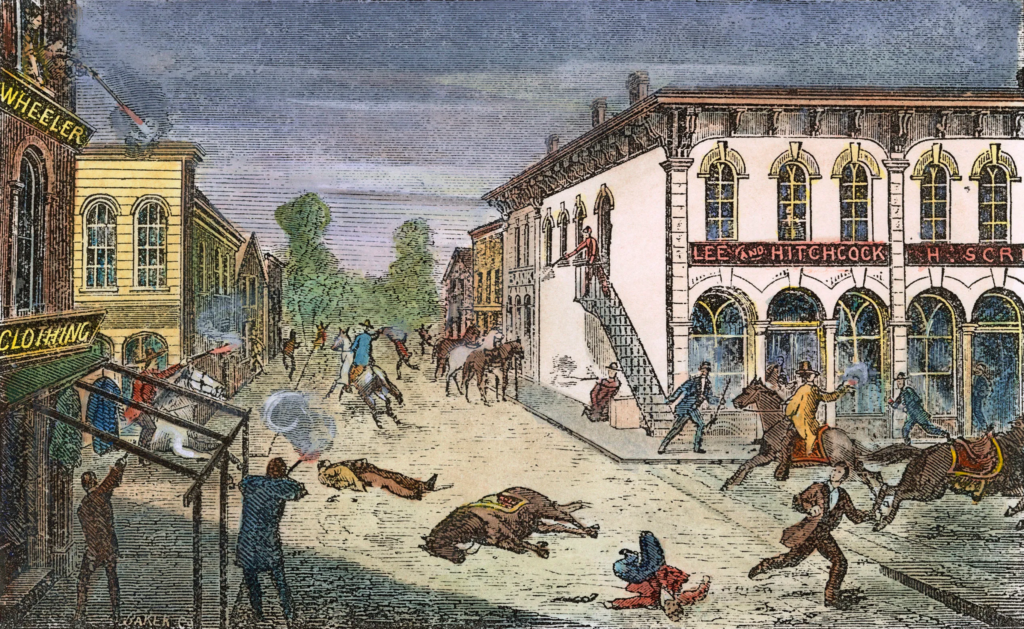
Outlaws, lawmen, scouts, and cowhands who learned their trade in 1861–1865
The Wild West is remembered as cowboys and outlaws. Look closer at who those cowboys and outlaws actually were. Jesse James — Civil War veteran. Wild Bill Hickok — Civil War veteran. Buffalo Bill Cody —Civil War veteran. The marshal who led the fight at the O.K. Corral — Civil War veteran. The West was not only settled by veterans. In the twenty-five years after Appomattox, a striking share of the people who gave the frontier its reputation had already been trained, armed, and hardened by the Civil War.
When the fighting ended in 1865, more than three million men had worn a uniform.[1] They knew how to ride, shoot, march, and live with sudden violence. A great many of them had no interest in going quietly back to the farm. They went west for land, gold, wages, and a second chance. After World War II, some veterans bought motorcycles, chased adrenaline, and founded clubs — the Hells Angels among them. After the Civil War, the same restlessness took a different shape. Men saddled a horse and rode west.
The so-called Wild West was a short window, roughly 1865 to 1890. In that window, a huge share of the people living it — outlaws and lawmen, scouts and gunfighters, and thousands of miners and cowboys whose names never made a dime novel — were Civil War veterans. The famous names only make the pattern easy to see.
Missouri Guerrillas Turned Outlaws
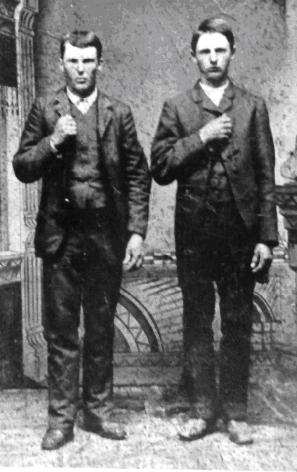
Start with the outlaws, because some of the most famous from this period in American history learned their methods in Missouri, not in Dodge City.
Missouri in the Civil War
Missouri was not a normal Civil War state. It was a border war of neighbors killing neighbors, and it produced a different kind of soldier: the guerrilla. Frank James joined the pro-Southern Missouri State Guard in 1861. He fought at Wilson’s Creek and Lexington. By 1863, he was riding with William Clarke Quantrill.[2] If you know Quantrill, you know what that meant. On August 21, 1863, Quantrill’s raiders rode into Lawrence, Kansas, and burned much of the town. Frank James was there. So was Cole Younger, who had left his family’s farm near Lee’s Summit at seventeen to join the same band. [3][4
Jesse James was younger. He was sixteen when Union militiamen came to the family farm, beat his stepfather, and — according to later family accounts — whipped Jesse himself. He joined “Bloody Bill” Anderson, the most savage of the Missouri guerrilla captains. In September 1864, at Centralia, Anderson’s men stopped a train, pulled unarmed Union soldiers off it, and executed them. Jesse was in that command. He was wounded twice before the war ended. He was eighteen.[5][6]
When the armies stacked their arms in 1865, these men already knew how to ride hard, hit fast, rob, and disappear into the brush. That was guerrilla warfare. Their postwar career was the same work with different targets.
The James-Younger Gang
On February 13, 1866, a band of former Missouri guerrillas walked into the Clay County Savings Association in Liberty in broad daylight and rode off with about $60,000 in cash and bonds. A bystander, a young student named George Wymore, was shot dead in the street. Historians treat the Liberty holdup as the first successful daylight bank robbery of the postwar United States. Frank James and Cole Younger are widely believed to have carried out the raid. Jesse, still recovering from a chest wound, may not have been.[7] The method, in any case, was the method they already knew.
They did not stop. Over the next decade, the James-Younger Gang hit banks in Kentucky and Missouri and, in 1873, tried something new. West of Adair, Iowa, they pulled the spikes from a rail on the Chicago, Rock Island & Pacific, wrecked the train, and robbed the express car. Engineer John Rafferty was killed in the derailment. The gold shipment they wanted was not aboard. They took a few thousand dollars. What they proved was that a cavalry raid could be turned into a train robbery.[8]
The End of the Gang
It lasted until September 7, 1876, in Northfield, Minnesota. The gang tried the First National Bank in daylight. The town fought back. Two raiders died in the street. Cole Younger was hit repeatedly — later accounts say eleven wounds — and captured with his brothers. Jesse and Frank escaped. The gang as a working unit was finished. Jesse kept robbing until April 3, 1882, when Robert Ford shot him in the back of the head in St. Joseph for the reward. Frank James lived until 1915. Cole Younger walked out of Stillwater prison in 1901 and spent his last years on the lecture and Wild West-show circuit.[9][10]
Sixteen years as the country’s most wanted outlaws. The tactics came out of Missouri guerrilla war. Jesse James is arguably the most famous figure to come out of the Wild West.
Same War, Different Sides
It was not only the Confederates. Union veterans went west too. Some of their job titles include lawman, scout, and showman.
Wild Bill Hickok
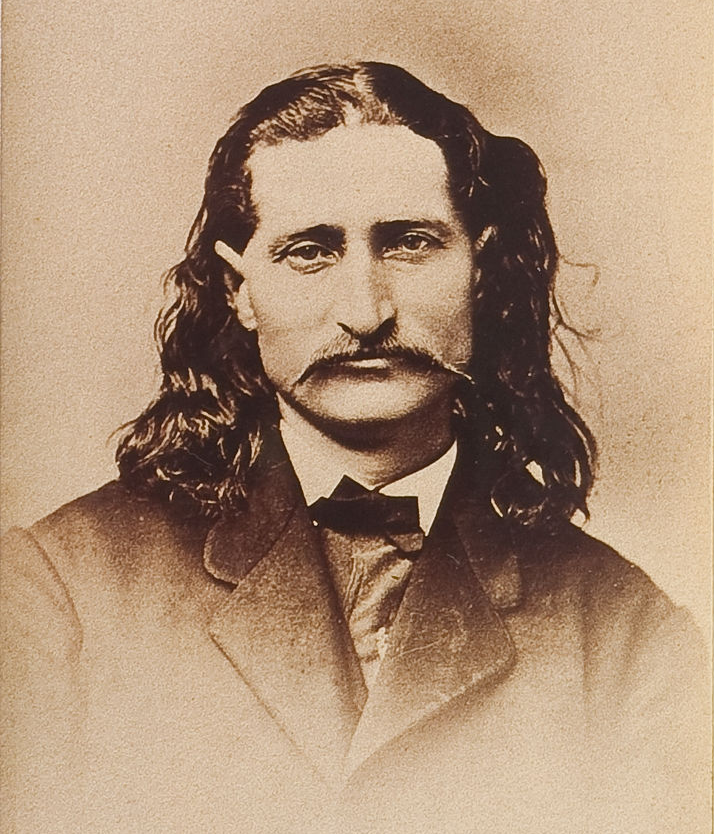
Born James Butler Hickok — worked the Union side as a teamster, wagon master, detective, scout, and, by some accounts, a spy. The war taught him to stay calm when someone was shooting.[11]
His Wild West reputation began almost immediately. On July 21, 1865, in the public square at Springfield, Missouri, he and Davis Tutt faced each other at long range over a gambling debt and a stolen watch. Both fired. Tutt missed. Hickok’s shot struck Tutt in the chest. Historians still call it the first well-documented quick-draw duel of the postwar West. A jury acquitted Hickok.[12]
Then came the lawman years. In 1869 he was sheriff in Hays City, Kansas, a violent railroad town, and killed men who tried him. In 1871, Abilene hired him as marshal. Abilene was the end of the Chisholm Trail. Texas drovers arrived by the thousand, armed and paid. Hickok’s job was to keep the lid on. He crossed paths that summer with a young John Wesley Hardin, already a killer; the two men reached an uneasy truce rather than a gunfight.[13] In October he killed saloon owner Phil Coe after Coe fired first, then in the same confused exchange fatally shot his own deputy, Mike Williams, who was running to help. It was Hickok’s last killing as a lawman. In 1876, in a Deadwood saloon, he was shot in the back while holding aces and eights — still called the dead man’s hand.[14]
Buffalo Bill Cody
Cody took a parallel path and then turned it into a business. He enlisted in the 7th Kansas Cavalry as a teenager and served until 1865. After the war, the Army hired him as a civilian scout because a veteran cavalryman could ride and read ground.[15] From 1867 to 1868, the Kansas Pacific paid him to feed construction crews. By his own count, he killed more than 4,200 buffalo. That is where the name came from.[16]
From 1868 to 1872 he was chief of scouts for the 5th U.S. Cavalry on the Plains, including the fight at Summit Springs in 1869. In 1872, he received the Medal of Honor for gallantry while scouting near the Platte. (The Army later stripped civilian scouts of the medal on a technicality; Cody’s was restored in 1989.)[17] In 1883, he did something no other scout managed as well. He packaged the frontier and sold it. Buffalo Bill’s Wild West toured America and Europe for three decades with Annie Oakley, stagecoach holdups, Pony Express rides, and, in 1885, Sitting Bull himself in the cast. Cody took what the Army had taught him to do and made it the most famous show on earth.[18]
Texas Jack Omohundro
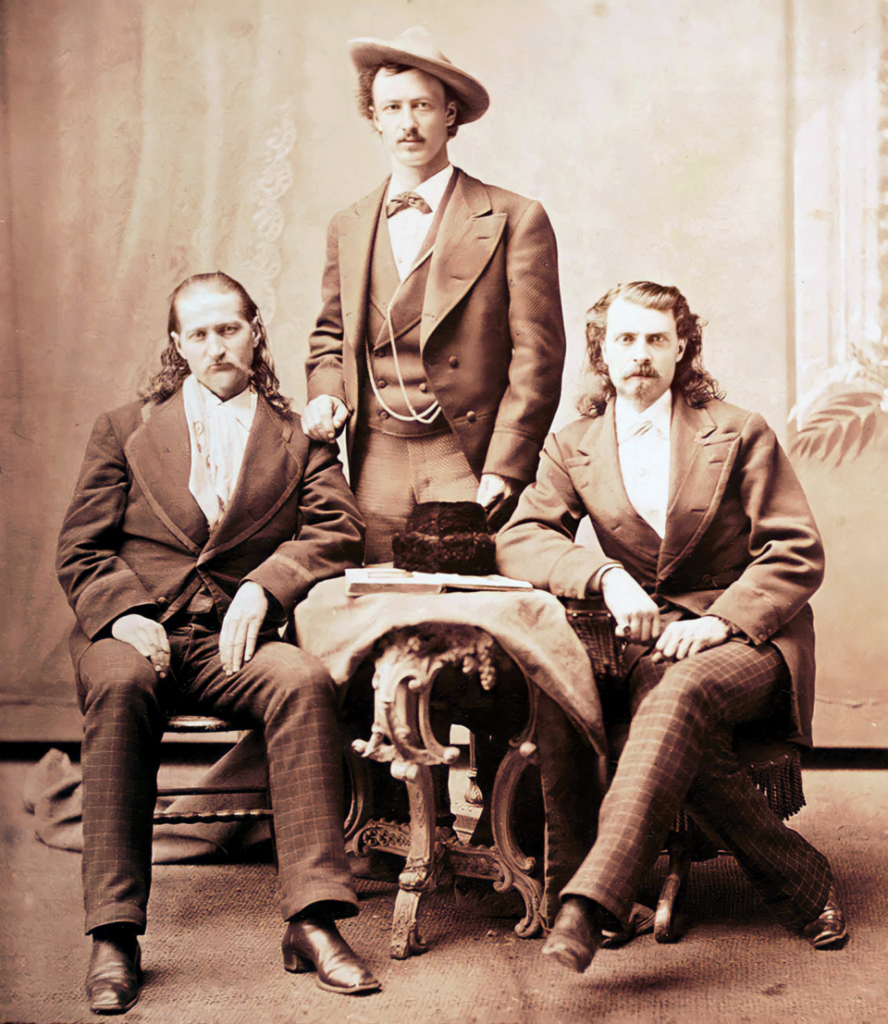
Omohundro is the bridge between the two sides. John Baker Omohundro was a Virginia Confederate, a courier and scout in J. E. B. Stuart’s command. He enlisted in the 5th Virginia Cavalry, was wounded, and later scouted under Fitzhugh Lee.[19] After the war, he went to Texas, worked cattle, and picked up the nickname on a drive north. By 1869 he was on the Plains, scouting for the Army, hunting with Cody, and drinking with Hickok. In 1872 he joined Cody and Hickok on a Chicago stage in The Scouts of the Plains — one of the first Wild West theatricals in the country. He married the Italian ballerina Giuseppina Morlacchi, appeared in dime novels, and died of pneumonia in Leadville, Colorado, in 1880. He was thirty-three. Confederate cavalryman, Texas cowboy, Army scout, stage star: the whole postwar script in one short life.[20]
Texas Gunfighters
Not every veteran became a showman. Some carried the war into the Wild West saloons and the streets.
Clay Allison
Clay enlisted in the Confederate army in 1861, was discharged for a head injury that doctors already linked to violent episodes, and reenlisted anyway in the Tennessee cavalry, under Nathan Bedford Forrest. That tells you the kind of unit it was, and the kind of man he was.[21] After Appomattox, he turned up in the Cimarron country of New Mexico as one of the most dangerous men on that stretch of frontier.
In January 1874, at the Clifton House, he sat down to dinner with gunman Chunk Colbert. Colbert went for a pistol under the table. The barrel snagged. Allison shot him in the head.[22] He later killed Constable Charles Faber in Las Animas after Faber tried to take his guns. In Cimarron he ran with lynch crowds; the St. James Hotel still markets the bullet-scarred ceiling from those years. Allison never took a badge. He was one of the most feared men in the west. He died in 1887 in a very unusual way, thrown from a wagon, his neck broken.[23]
Ben Thompson
Ben was Confederate cavalry too — 2nd Texas, under John S. “Rip” Ford. He fought at Galveston, was wounded, and after the war made his living as a gambler and what newspapers called a shootist.[24] By the late 1870s he was running faro in Austin and San Antonio and had killed men who tried him, including theater owner Mark Wilson in Austin in 1876. Austin then did something that only makes sense if you understand the postwar West. In 1880 the city elected him marshal. For two years the argument was that a man that deadly might keep other deadly men quiet. He was, by contemporary accounts, effective. Then he went back to the gambling rooms. On March 11, 1884, he walked into San Antonio’s Vaudeville Theatre with his friend King Fisher. Both were shot from behind. A lot of Texans then and later called it a setup.[25][26]
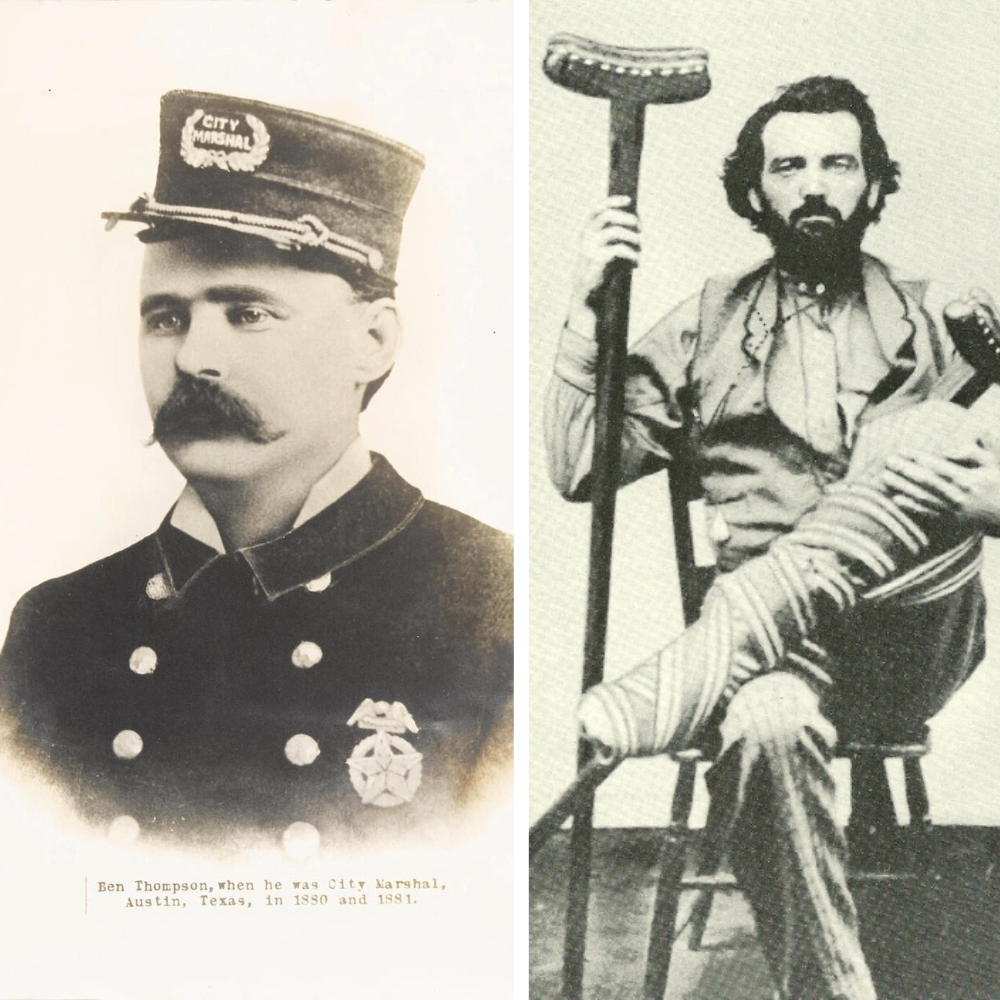
The Names We Do Not Know — and the Marshal History Forgot
The gunfighters are the easy story. The larger fact is quieter. In the mining camps at Central City and Virginia City, on the cattle trails out of Texas, and on the Union Pacific grade, thousands of the men swinging a pick or riding nighthawk in the late 1860s and 1870s had been Civil War veterans.
The Homestead Act of 1862, rewritten after the war to credit Union service against the residency clock, pulled veterans onto claims from Nebraska to Dakota. Mining rushes and railroad payrolls pulled the rest.[27][28] Popular histories sometimes say that as many as a third of the early Chisholm Trail cowboys were former soldiers. The fraction is hard to prove. The direction of the evidence is not. Texas had sent tens of thousands of men into Confederate service. When they came home to a ruined cattle economy, the trail north was one of the jobs that paid. Union and Confederate veterans ended up in the same crews, five years after trying to kill each other.[29]
The best example of the forgotten veteran who became a lawman is not Wyatt Earp. It is his older brother.
Virgil Earp
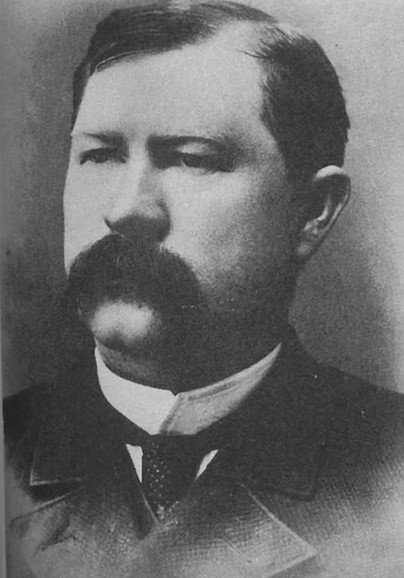
The elder Earp enlisted in the 83rd Illinois Infantry and spent the war on garrison duty in Tennessee. It was not a famous combat record. It was an education in discipline, procedure, and chain of command.[30] Before Tombstone, he wore a badge in Prescott. In 1879 he went to Arizona as a deputy U.S. marshal. In 1881, Tombstone made him city marshal — the chief. Wyatt was his deputy. Morgan was his other deputy. Doc Holliday was a man Virgil temporarily swore in.
October 26, 1881, was not a myth about cowboys versus lawmen. It was a city ordinance against carrying guns, enforced by a Union infantry veteran. Virgil led the party down Fremont Street to disarm Ike Clanton’s crowd near the O.K. Corral. The gunfight lasted about thirty seconds. Three Cowboys were dead. Virgil had been in command.[31]
The payback came on the night of December 28. Walking down Allen Street from the Oriental Saloon toward the Cosmopolitan Hotel, Virgil was hit by three shotgun blasts from an unfinished building across the way. Buckshot shattered his left arm. The surgeon, George Goodfellow, cut out inches of bone. Virgil never got the arm back. He survived, served as a lawman again in California, and died in 1905. He carried a western wound the way other men carried a Civil War wound.[32]
The War Went West
Jesse and Frank James and Cole Younger were Confederate guerrillas who spent sixteen years as outlaws using cavalry tactics. Wild Bill Hickok was a Union scout who became the marshal of Abilene. Buffalo Bill Cody was a Union cavalryman who became a Medal of Honor scout and then, for thirty years, the most famous showman in the world. Texas Jack Omohundro was a Confederate courier for J. E. B. Stuart who became a cowboy, an Army scout, and a Wild West stage star. Clay Allison and Ben Thompson were Confederate cavalrymen who became the most feared gunfighters in Texas — one of them was hired as city marshal of the state capital. Virgil Earp was a Union infantryman who was the actual ranking lawman at the O.K. Corral.
Different sides of the war. Different stories. The same generation. Around them were thousands more veterans who came west as miners, cowboys, and homesteaders looking for land, wages, and whatever came next.
Notes
- National Park Service, “Facts,” The Civil War, nps.gov/civilwar/facts.htm. Union enlistments totaled about 2.67 million; Confederate estimates range from roughly 750,000 to 1.2 million.
- Deborah Keating, “James, Frank and Jesse,” Civil War on the Western Border, Kansas City Public Library / Missouri State Archives.
- Mark Lee Gardner, “How Jesse James Became America’s Most Popular Criminal,” National Geographic History, January 16, 2019.
- “Cole Younger (1844–1916),” Missouri Encyclopedia, State Historical Society of Missouri.
- “A Hard School for Hard Men: Guerrillas Such as the James Boys Became Outlaws,” HistoryNet, August 17, 2017.
- T. J. Stiles, quoted in “Guerrilla Massacre at Centralia Shaped Jesse James,” RealClearHistory / American Experience, September 2019; Keating, “James, Frank and Jesse.”
- Matthew C. Hulbert, “The Razor’s Edge of Borderland Politics: Edward M. Samuel and the Liberty Bank Robbery,” Civil War Governors of Kentucky, July 12, 2016; Kansas City Star, “Jesse James Bank Museum in Liberty,” October 8, 2025. Historians generally credit former Missouri guerrillas, including Frank James and Cole Younger. Jesse James was likely still recovering from a chest wound and may not have taken part.
- Adair County Conservation, “Jesse James Historical Park”; Cheryl Mullenbach, “Daring Robbers Terrorize Train Passengers,” Investigate Midwest, February 18, 2015.
- Ron Way, “Northfield’s ‘Defeat of Jesse James’: Last Gasp of the Civil War,” Minneapolis Star Tribune, September 2, 2016; Missouri Encyclopedia, “Cole Younger.”
- Keating, “James, Frank and Jesse.” Jesse James was shot by Robert Ford in St. Joseph on April 3, 1882. Frank James died of natural causes on February 18, 1915.
- Blackhawk Museum, “Wild Bill Hickok” (archived); biographical summaries in Britannica, “Wild Bill Hickok.”
- “Wild Bill Hickok: The Legendary Lawman of the Wild West,” TheCollector, April 30, 2025; Britannica, “Wild Bill Hickok.” The Springfield square duel of July 21, 1865, is widely treated as the first well-documented quick-draw confrontation of the postwar West.
- HISTORY.com, “John Wesley Hardin Arrives in Abilene, Befriends Wild Bill Hickok,” June 1, 1871. The two men struck an uneasy acquaintance. Later claims that Hickok disarmed Hardin without a shot come chiefly from Hardin’s own account and should be treated with caution.
- True West Magazine, “A Troubled Law Officer,” May 1, 2024; Legends of America, “Phil Coe – Gunfighter and Gambler.” Hickok killed Coe on October 5, 1871, and in the same exchange fatally shot his own deputy, Mike Williams.
- Britannica, “Buffalo Bill”; Encyclopedia of the Great Plains, “Cody, Buffalo Bill (1846–1917).” Cody enlisted in the 7th Kansas Cavalry in 1863 and served through 1865.
- Buffalo Bill Center of the West, “Buffalo Bill and His Horses,” Points West Online, February 21, 2014. Cody claimed about 4,280 buffalo killed while supplying Kansas Pacific crews. The figure is his own count.
- HistoryNet, “Bill Cody: On the Trail of the Indians,” September 19, 2017; True West, “Showman of the West,” September 3, 2022. Cody received the Medal of Honor in 1872 as a civilian scout. The Army revoked civilian scout medals in 1917; Congress restored Cody’s in 1989.
- Britannica, “Buffalo Bill”; HISTORY.com, “The Unlikely Alliance Between Buffalo Bill and Sitting Bull,” October 24, 2017. Buffalo Bill’s Wild West opened in 1883. Sitting Bull toured with the show for about four months in 1885.
- Edgar P. Sneed, “Omohundro, John Burwell, Jr.,” Handbook of Texas, Texas State Historical Association; Texas Jack Association; Buffalo Bill Center of the West, “Texas Jack.”
- Texas Highways, “Who Was the Historic Figure Behind Texas Jack Wild West Outfitter,” May 20, 2022; True West, “The Tragedy of Texas Jack,” February 11, 2019. Omohundro died of pneumonia in Leadville, Colorado, on June 28, 1880, at age 33.
- C. L. Sonnichsen, “Allison, Robert Clay,” Handbook of Texas, Texas State Historical Association. Allison enlisted in 1861, received a medical discharge in January 1862 after a childhood head injury, then reenlisted in what became Biffle’s Tennessee cavalry and finished the war with Forrest’s corps, paroled at Gainesville, Alabama, in May 1865.
- Legends of America, “Chunk Colbert – New Mexico Bad Boy.” The Clifton House killing is dated January 7, 1874 (sometimes given as 1875 in later retellings). Colbert was reputed to have killed several men; the confirmed record is thinner.
- Sonnichsen, “Allison, Robert Clay”; Legends of America, “New Mexico Bad Boy – Clay Allison.” Allison killed Constable Charles Faber in Las Animas, Colorado, in December 1876 after Faber tried to enforce a no-weapons ordinance. He died on July 1, 1887, after falling from a wagon.
- “Thompson, Ben,” Handbook of Texas, Texas State Historical Association. Thompson enlisted June 16, 1861, in Col. John S. “Rip” Ford’s 2nd Texas Cavalry, fought at Galveston, and was wounded.
- KUT, “Meet Austin’s Gunslinging Lawman, Ben Thompson,” January 14, 2015; Handbook of Texas, “Thompson, Ben.” Austin voters elected him city marshal in December 1880 and again in 1881. He resigned after killing Vaudeville Theatre owner Jack Harris in San Antonio in July 1882; a jury acquitted him.
- Handbook of Texas, “Thompson, Ben.” Thompson and John King Fisher were shot from behind at San Antonio’s Vaudeville Theatre on March 11, 1884. Contemporaries widely believed the killing was arranged by Harris’s associates.
- American Battlefield Trust, “The Homestead Act of 1862,” battlefields.org. Union veterans could subtract wartime service from the five-year residency requirement.
- Kurt Hackemer, “A Place of Their Own: Veterans of the Civil War,” HistoryNet, June 16, 2021. Veteran colonies took root in Nebraska, Kansas, and Minnesota in 1871–72.
- American Battlefield Trust, “The Homestead Act of 1862”; HistoryNet, “A Place of Their Own.” Claims that “a third of early Chisholm Trail cowboys were former soldiers” circulate in popular histories but are not tightly documented. What is well established is that Texas cattle work absorbed large numbers of discharged Confederates, and that Black cowboys — many of them formerly enslaved cattle hands — made up a substantial share of trail crews.
- Legends of America, “Virgil Earp – Upholding the Law of the West”; OldWest.org, “Virgil Earp: The Real Frontier Marshal of Tombstone,” March 3, 2023. Virgil enlisted in the 83rd Illinois Infantry in 1862 and served into 1865, much of it on garrison duty in Tennessee.
- OldWest.org, “Virgil Earp”; Voices of the West, “Scott Dyke: Virgil Walter Earp — The Real Law in Tombstone.” Virgil was both city marshal and a deputy U.S. marshal. Wyatt and Morgan were deputies he called on. Doc Holliday was temporarily deputized for the confrontation.
- Destination4x4, “The Assassination Attempt of Virgil Earp — December 28, 1881”; True West, “Shotguns at Midnight.” Three shotgun blasts from an unfinished building on Allen Street shattered Virgil’s left arm. Dr. George Goodfellow removed several inches of humerus. Virgil never regained full use of the arm. He later served as a lawman in California and died in Goldfield, Nevada, in 1905.
