
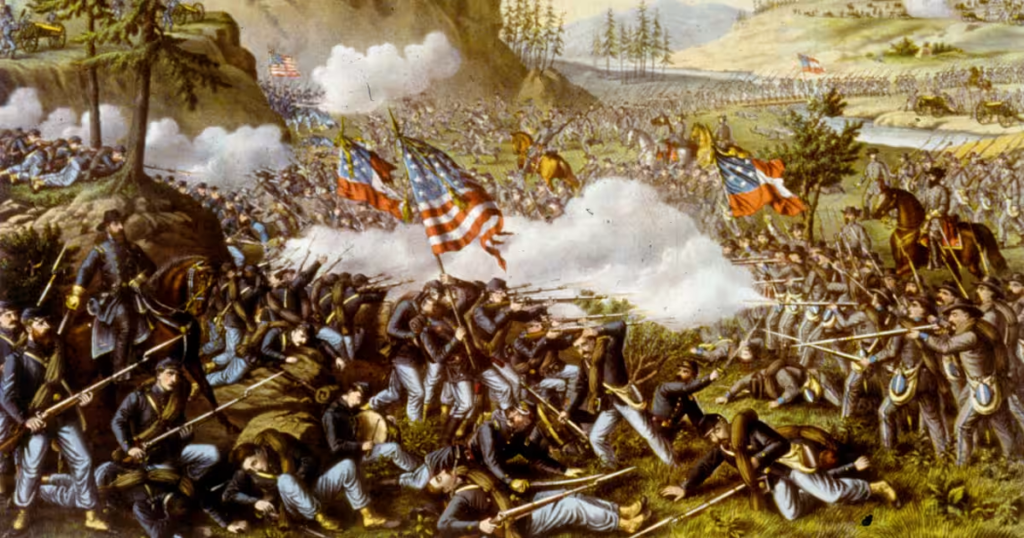
How a broken Confederate command structure, a bad Union order, and one general who stayed on the field decided the second bloodiest battle of the Civil War.
On the morning of September 20, 1863, near Chickamauga Creek, a Union division commander received what looked like a routine order: close up on the unit to your left. The problem was that the unit to his left was already in position. There was no gap to close. He had been dressed down the day before for questioning orders, so he pulled his entire division out of the line and marched away.
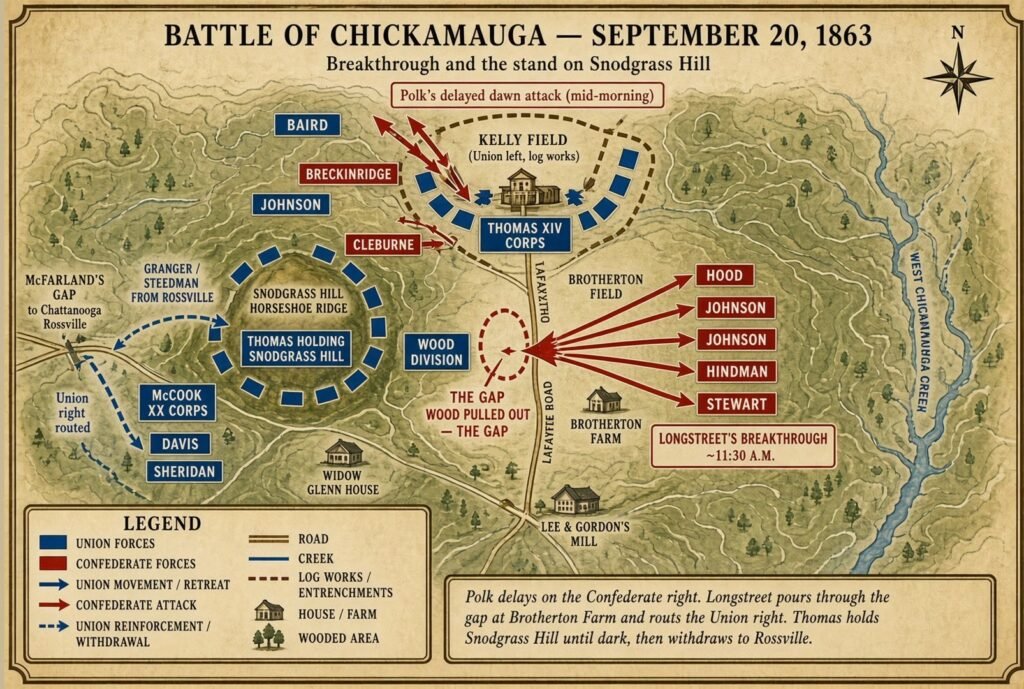
That opened a hole about a quarter-mile wide in the center of the Army of the Cumberland. A few hundred yards off in the woods stood Lieutenant General James Longstreet, Robert E. Lee’s senior corps commander, just in from Virginia with a column stacked deep for an assault. Twenty minutes later the Union right flank no longer existed. [1]
Chickamauga was the second-bloodiest battle of the Civil War. About 34,600 men fell in two days of fighting—more than at Shiloh, more than at Antietam. Only Gettysburg was worse. It was also the Confederacy’s largest tactical victory in the West. It bought them almost nothing.[2]
The Army That Would Not Strike
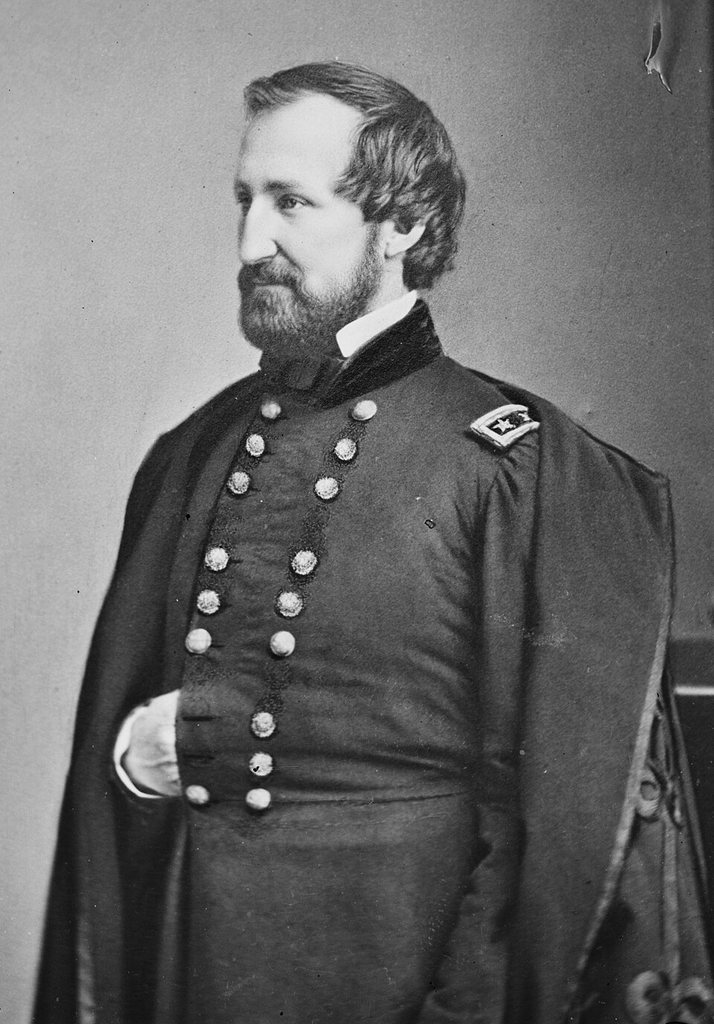
Late August 1863. Major General William S. Rosecrans and the Army of the Cumberland had just pushed General Braxton Bragg’s Army of Tennessee out of Middle Tennessee in the Tullahoma Campaign without a real battle. Major General Nathan Bedford Forrest, one of Bragg’s cavalry commanders, had warned that the blow was coming. Bragg was caught flat-footed anyway. His Duck River line collapsed, and he fell back toward Chattanooga.[3]
Rosecrans Divides His Army
Chattanooga was the prize: the rail junction that tied the Confederacy together from east to west. The mountains south of the Tennessee River would not allow a single line of advance, so on August 16 Rosecrans started his three infantry corps through separate gaps—Major General George H. Thomas’s XIV Corps, Major General Alexander McCook’s XX Corps, and Major General Thomas L. Crittenden’s XXI Corps. Not just separate corps. Separate divisions, scattered across forty to fifty miles of mountain country, none of them able to reach another in less than a day.
It was a reckless way to move an army. Rosecrans did it on purpose. He was convinced Bragg would not fight. Against Lee in Virginia, or against Stonewall Jackson before Chancellorsville, the Army of the Cumberland would have been destroyed piece by piece. The question that decided this campaign was simpler: could Bragg’s army do it?
Bragg ordered Forrest and Major General Simon B. Buckner, who had been holding East Tennessee, to pull toward his right. That meant giving up Knoxville. Major General Ambrose Burnside’s Army of the Ohio walked into the city in early September.[4]
Forrest Sees an Opportunity
Forrest saw the opening at once. Burnside was out there alone. The Army of Tennessee could concentrate against him with a heavy advantage and wreck him before Rosecrans could interfere. Bragg did not take the bait. He started evacuating Chattanooga instead. Rosecrans walked into the city on September 9.
Rosecrans kept dividing. Forrest reported Crittenden’s corps strung out and unsupported—two divisions across Chickamauga Creek and a third several miles off at Lee and Gordon’s Mills. Bragg was a short march away with his army concentrated. Forrest worked out the details: seize Red House Bridge in Crittenden’s rear and the Union retreat was cut off. Bragg moved the other direction. Opportunity gone.
That was twice in a week that his cavalry commander handed him an isolated enemy force and a plan to destroy it.
What Bragg Did Right
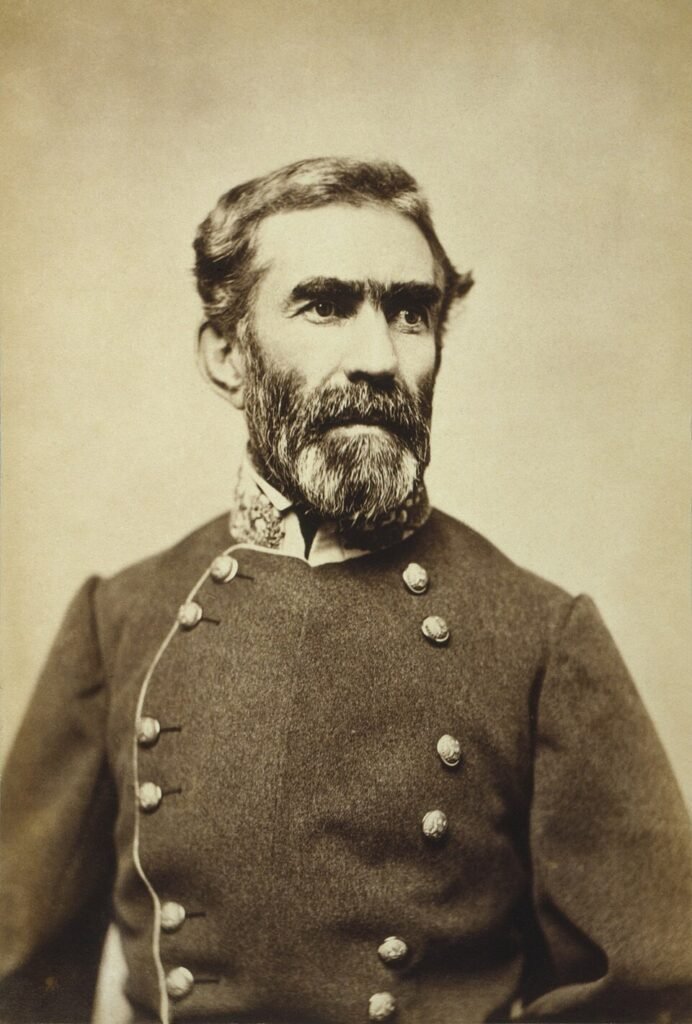
Here the story gets less simple, because this is where Bragg did everything right—and still got nothing.
Major General James S. Negley’s Union division, part of Thomas’s corps, marched into McLemore’s Cove, a dead-end valley with Confederate troops on three sides. Bragg saw it and ordered Major General Thomas C. Hindman to attack. The attack never happened. Hindman hesitated and asked for clarification. He held a council of war. Lieutenant General Daniel Harvey Hill sent word, through Major General Patrick Cleburne, that the attack was not practical. The hours went by. By the time anyone was ready to move, Negley had walked back out of the trap.[5]
Two days later Bragg ordered Lieutenant General Leonidas Polk—his senior corps commander, and an Episcopal bishop—to hit Crittenden at Lee and Gordon’s Mills. Polk did not attack either.
So the same commander who ignored Forrest twice then gave two direct attack orders, and his corps commanders simply did not carry them out.
Lost Opportunity
On September 13, Rosecrans finally realized his scattered army was in mortal danger and ordered it to concentrate. That took four days. McCook, way south near Alpine, Georgia, took the long road back over Lookout Mountain and did not close on Thomas until the 17th. Bragg and his corps commanders had four more days to destroy the Army of the Cumberland in pieces. They could not do it.[6]
Bragg is the easiest villain in the Confederate army, and a lot of accounts stop there. The record is messier. He missed what Forrest handed him, twice at least. But when he finally pointed at a target and said attack, nothing happened. Hindman would not attack. Polk would not attack. Hill sent back objections.
An army fails like this at both ends of the chain of command. The man at the top would not act on good intelligence, and the men below him would not act on clear orders. The Army of Tennessee had stopped functioning as a command structure months earlier, and everyone in it knew it.
Hold onto that. It happens one more time in this story—after Bragg has won.
By the morning of September 18, most of the Army of the Cumberland was concentrated near Chickamauga Creek. Every advantage Bragg had was gone. That is the moment he decided to attack.
Too Late
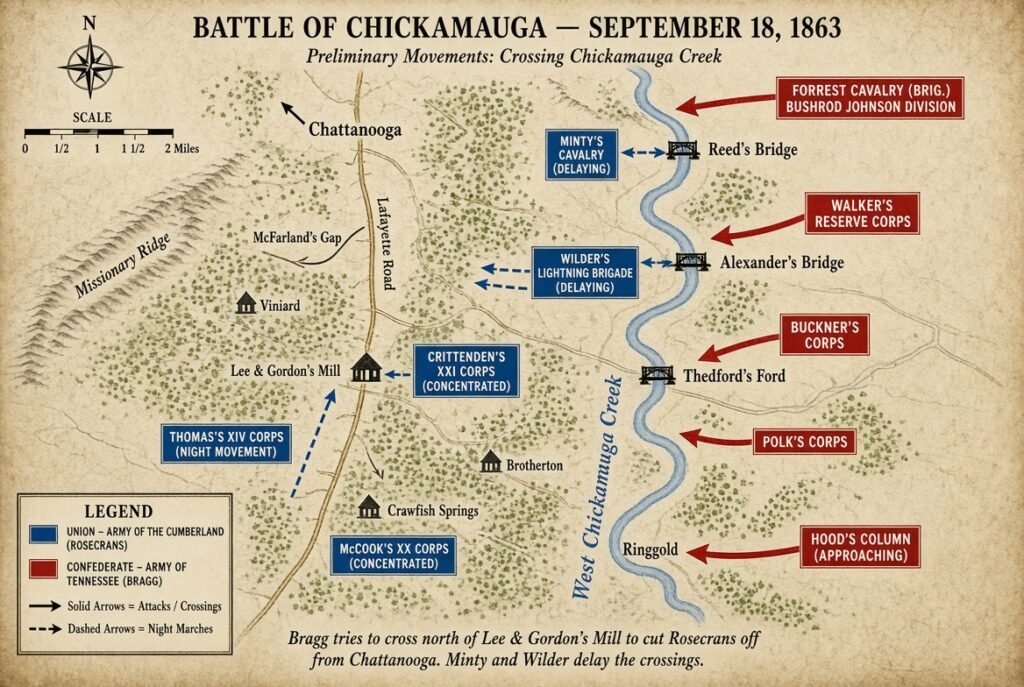
September 18, 1863
On September 18, the armies collided at the crossings of West Chickamauga Creek—Reed’s Bridge, Alexander’s Bridge, Thedford’s Ford. Colonel Robert Minty’s cavalry and Colonel John T. Wilder’s mounted “Lightning Brigade” delayed the Confederate crossings long enough to wreck Bragg’s timetable.[7]
September 19, 1863
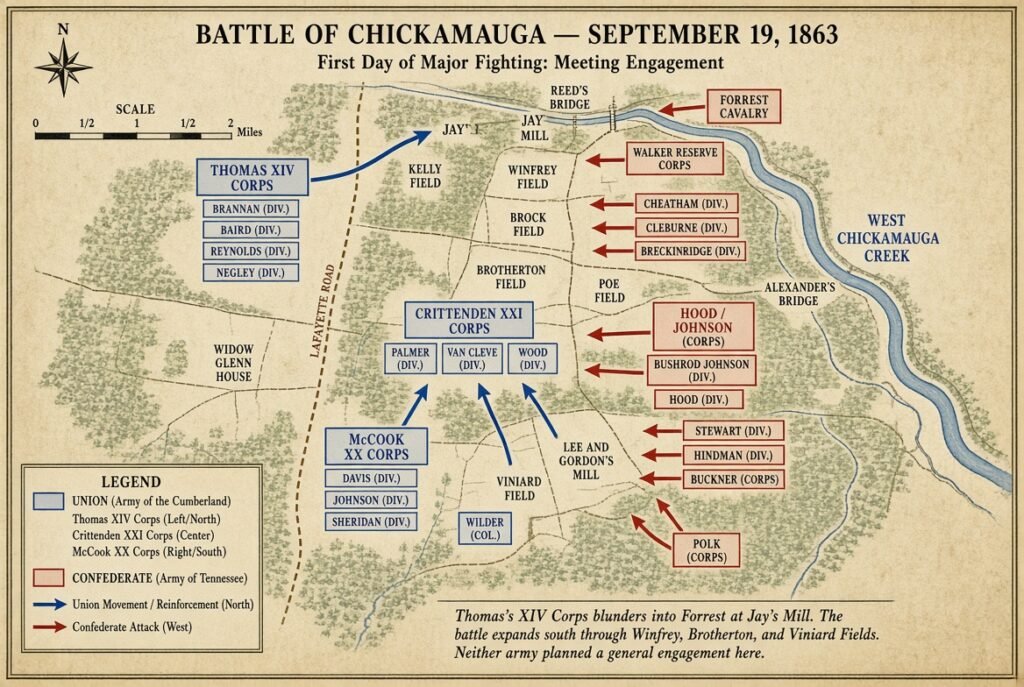
On September 19, full-scale fighting broke out in woods so thick that nobody could see more than a hundred yards. Both sides fed brigades in as they arrived. It was chaotic, inconclusive, and enormously costly. Thomas’s XIV Corps blundered into Forrest near Jay’s Mill, and the fight spread south through Winfrey, Brotherton, and Viniard Fields. Neither army had planned a general engagement there.
Samuel Watkins of the 1st Tennessee was in that army. In Company Aytch he remembered what it felt like to wait:
“Reader, were you ever held in reserve of an attacking army? To see couriers dashing backward and forward. To hear the orders given to the brigades, regiments, and companies. To see them forward in line of battle, the battle flags waving.“
Longstreet Arrives From Virginia
That night Longstreet arrived from Virginia. Bragg reorganized the Army of Tennessee into two wings and laid out a sequence of attacks from the right, rolling left, to cut Rosecrans off from Chattanooga. Polk would have the right wing. Longstreet would have the left—Hood’s men from Virginia, Hindman’s division, Bushrod Johnson’s column, and Buckner’s corps.[8]
It was a sound plan. It started hours late. Polk’s attack didn’t go in until well after sunrise on the 20th, and it went in piecemeal against Thomas, who spent the night building log breastworks around Kelly Field. Confederates died in front of those logs all morning.[9]
Here is the irony worth saying out loud: that failed attack won the battle. Because Thomas, under heavy pressure, kept sending back for reinforcements.
The Gap
September 20
Rosecrans started stripping his right to feed his left. Division after division shifted north.
Then the order reached Brigadier General Thomas J. Wood, commanding the 1st Division of Crittenden’s XXI Corps: close up on Major General Joseph J. Reynolds, the division on his left, and support him. Reynolds was already in line. Brannan’s division was already between them. The order made no sense. But Rosecrans had publicly dressed Wood down for delay the day before, so Wood obeyed the order exactly as written and marched out of the line near Brotherton Farm.[10]
Quarter-mile hole. Dead center of the Union army.
Confederates Exploit
Longstreet had massed his brigades in column, deep rather than wide, aimed at exactly that stretch of woods. He had no idea the gap was there. It was an accident of timing.
Around 11:30 a.m. the column went forward and found nothing in front of it. Brigadier General Bushrod Johnson’s men, leading the assault, poured through, wheeled, and rolled up the Union line from the inside. Whole brigades were wrecked before they could even change facing. Rosecrans, McCook, and Crittenden were swept off the field in the rout and rode for Chattanooga convinced the army was finished. About a third of the Union army was gone in an hour.[11]
Thomas Holds
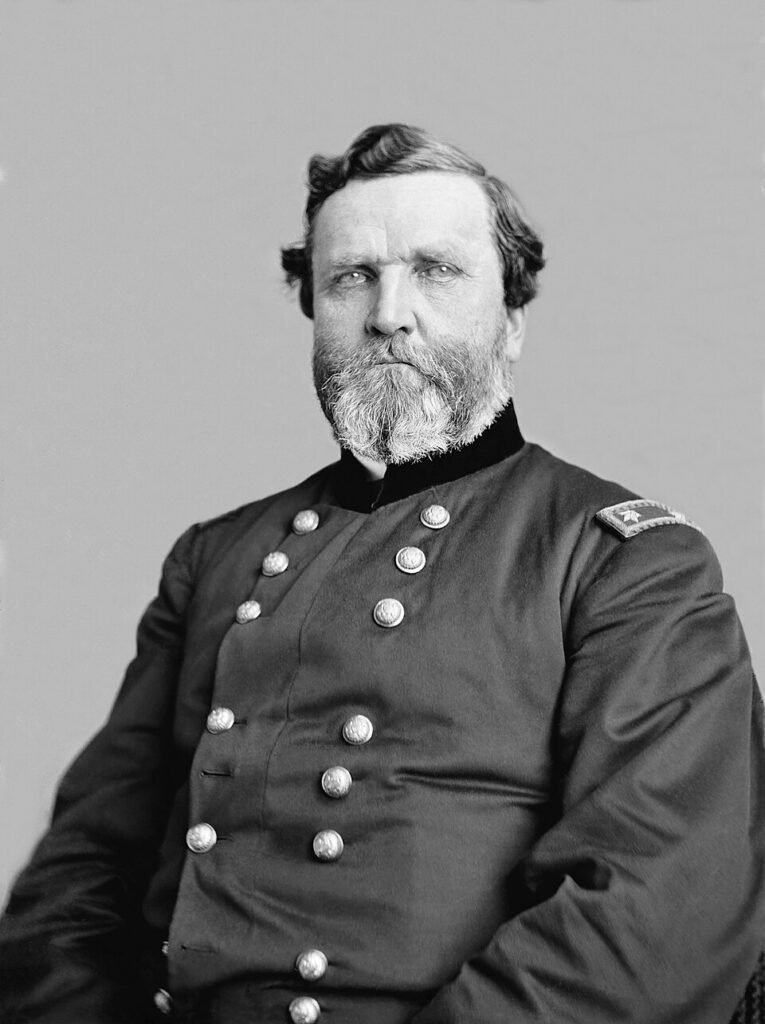
What was left assembled on Horseshoe Ridge and Snodgrass Hill. Thomas took command of it, though nobody had ordered him to. He pulled units from wherever he could find them. Confederate attacks came up the slope all afternoon. Men ran out of ammunition and held with bayonets.[12]
And then the contrast that makes the whole story work.
Major General Gordon Granger, commanding the Union Reserve Corps, was sitting miles away near McAfee’s Church with orders to guard the road to Chattanooga. He heard the guns, decided his orders were wrong, and marched to the sound of the fighting without being told to. Brigadier General James B. Steedman’s division arrived with ammunition at the moment the ridge was about to break, and helped hold it.[13]
Two men, same field, same day. One followed an order he knew was wrong and opened a hole in his own army. One ignored his orders and saved it.
Thomas held until dark, then withdrew to Rossville in good order. He has been the Rock of Chickamauga from that day forward.
The Pursuit That Never Came
Tactically this was the largest Confederate victory in the western theater. Bragg had beaten a Union army in the field and driven it off. And then he stopped.
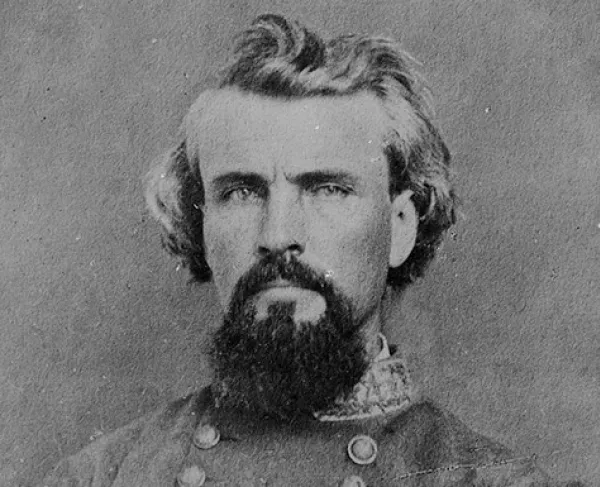
September 21. Forrest’s cavalry was pressing the retreat. He climbed a tree to see over the smoke, watched the Union army streaming into Chattanooga in disorder, and sent Bragg word to come on—that every hour of delay was worth thousands of men to the enemy. That same day Forrest asked an infantry division commander for support to push the pursuit. The man refused to move without orders.
Bragg did not come. His army was wrecked—about 18,450 Confederate casualties against about 16,170 Union—and he would not gamble again. Ten Confederate generals were killed or wounded. Rosecrans got into Chattanooga and dug in. Bragg laid siege instead of pursuing. Within two months Ulysses S. Grant, newly put over the Union armies in the West, arrived, broke the siege, and the road to Atlanta was open.[14]
After Chickamauga, Watkins walked that field afterward. In Company Aytch he wrote:
The Confederate and Federal dead, wounded, and dying were everywhere scattered over the battlefield. And then to see all those dead, wounded, dying horses, their heads and tails drooping, and they seeming to be so intelligent as if they comprehended everything, I felt like shedding a tear for those innocent dumb brutes.
The Confederacy’s greatest victory in the West bought them nothing, because the same disease that saved Negley at McLemore’s Cove was still killing them on the 21st: a commander who would not take the last risk, and subordinates who would not move without orders.
Forrest’s reaction to all of this is legendary. It ended with him confronting Bragg to his face.
Notes
- National Park Service, “Chickamauga Battlefield,” Chickamauga and Chattanooga National Military Park; NPS, National Register documentation on the Brotherton gap and Wood’s withdrawal.
- American Battlefield Trust, “Chickamauga Battle Facts and Summary.” Estimated casualties: 34,624 (Union 16,170; Confederate 18,454). The Trust ranks Chickamauga second only to Gettysburg in Civil War losses, and first in the Western Theater.
- National Park Service and contemporary campaign studies of the Knoxville / East Tennessee operations: Buckner evacuated Knoxville in late August; Burnside’s cavalry entered the city on September 2 and the main column on September 3.
- National Park Service and contemporary campaign studies of the Knoxville / East Tennessee operations: Buckner evacuated Knoxville in late August; Burnside’s cavalry entered the city on September 2 and the main column on September 3.
- U.S. Army, Chickamauga staff-ride materials; American Battlefield Trust, “Maneuvers at McLemore’s Cove.” Bragg ordered Hindman to strike Negley from the north while D. H. Hill came through Dug Gap. Hill delayed; Hindman and then Buckner failed to close the trap.
- Official reports of the Chickamauga Campaign and NPS campaign summaries: Rosecrans ordered concentration about September 12–13; McCook did not join Thomas at Stevens Gap until September 17. Flank-to-flank distance was about forty miles by the nearest roads, longer by the route McCook actually took.
- American Battlefield Trust maps and articles on Reed’s Bridge and Alexander’s Bridge, September 18, 1863.
- Lt. Gen. James Longstreet, official report of the Chickamauga Campaign, October 1863: he reported to Bragg about 11 p.m. on September 19 and was assigned the Left Wing (Hood, Hindman, Johnson, and Buckner’s corps).
- National Park Service, “Chickamauga Battlefield”: Bragg planned a dawn assault; miscommunication delayed Polk’s attack until about 9:30 a.m.
- NPS National Register narrative and park interpretation: Rosecrans, believing Brannan had left a hole, ordered Wood to “close up on Reynolds.” Wood, already criticized for delay, pulled out of line near the Brotherton farm and created a gap where none had existed.
- National Park Service, Chickamauga Battlefield history; American Battlefield Trust, September 20 maps. Johnson’s division led Longstreet’s column through the Brotherton gap around 11:30 a.m. Rosecrans, McCook, and Crittenden left the field; roughly a third of the army went with them.
- National Park Service, “George Thomas,” Chickamauga and Chattanooga NMP. Thomas organized the defense of Snodgrass Hill and Horseshoe Ridge and covered the withdrawal to Rossville.
- Chickamauga park tablet, “Reserve Corps,” Maj. Gen. Gordon Granger, September 20, 1 p.m.: Granger marched Steedman’s division from McAfee’s Church to the sound of the guns without orders and reported to Thomas near the Snodgrass house.
- American Battlefield Trust, “10 Facts: The Battle of Chickamauga,” and battle summary: Bragg lost nearly a fifth of his force and did not pursue into Chattanooga. Grant later broke the siege; the way to Atlanta followed.
- Samuel R. Watkins, Company Aytch: Or, A Side Show of the Big Show (1882). Quotations from Watkins’s Chickamauga chapters.
